
Ten Weeks of Muslim Mental Health Conversations: Key Themes, Topics, and Reflections
Ten Weeks of Muslim Mental Health Conversations: Key Themes, Topics, and Reflections
By Sayyid Sameer Ali
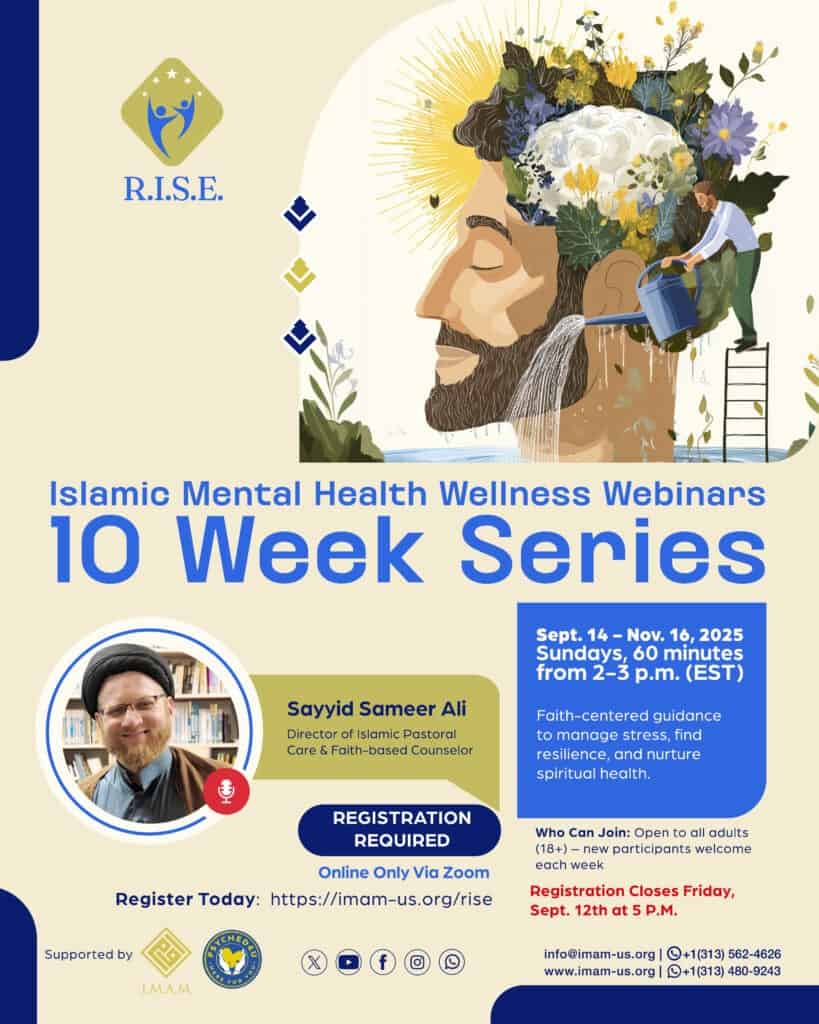
Recently a 10-week webinar on the topic of Islamic Mental Health Wellness was conducted by R.I.S.E between September and November 2025, facilitated by Sayyid Sameer Ali. Over 400 participants registered and many asked questions during the webinars by sending in their questions during registration. They were also able to use the Q&A option available via zoom or emailing questions about the topics to the facilitator. The participants were mainly located in North America and were adults over 18 years of age from both genders. Each webinar was an hour and fifteen minutes and many included fictional case studies. The topics of the webinar in a weekly sequence were as follows:
- Intro to Islamically Integrated Mental Health
- Stress Management in Daily and Seasonal Life
- Grappling with Grief
- Dealing with Depression
- Addressing Anxiety
- Tracing Trauma and PTSD
- Anger, Emotions, and Regulation
- Family Life and Mental Health: Roles, Boundaries, Support
- Addictions and Recovery
- Religion, Spirituality, and Islam on Wellbeing
The webinar was created in an attempt to increase mental wellness literacy amongst the Muslim public. The following article describes some of the main themes which the participants asked about, and attempts to answer some of their questions. Some of the questions can be divided into three main topics:
A. Faith, Identity, and Safety
B.. Communication, Community, and Wellness.
C. Family Dynamics and Mental Well-Being
Faith, Identity, and Safety
Some questions which were asked include “ Is it okay to confess sins to a therapist?” “How can a person open up to a therapist when it involves others’ information?” and
“Since many believe duas alone can fix mental health and it’s hard to find Muslim therapists, how can we handle that?”
These are great questions about the nature of therapy, the limitations of the therapeutic alliance, and the relationship between spiritual and mental wellness. Therapists are not priests, pastors, or clergy or religious scholars/ulama. They are trained professionals who work with clients to reach their therapeutic goals to and to provide the appropriate interventions relating to a client’s diagnosis. Is it okay to talk to a therapist about your sins? There is no concept of “confession of sins” in Islam. Islam does not consider confession an element of our religious practice. But is it okay to talk to a therapist, a kind stranger at the end of the day, about sins that none else may know about? The goal of therapy is to help a client reach wellness, and that may include addressing some behaviors and patterns of thought and action. For a therapist, the behavior may need to be addressed and fixed in the session. For the client, the particular behavior may appear as a sin and religiously may be considered an undesirable behavior.
For instance, if someone continuously is backbiting another person and knows that this is sinful behavior in Islam, they may talk to a therapist to find help in addressing this behavior. The therapist may explore emotional and psychological reasons why this client feels that they may want to talk about others. The therapist may explore religious teachings around this behavior, and then invite the client to internalize that this behavior is undesirable and that they can work with the therapist to address it and change it.
While speaking about other people in front of the therapist, the client may feel that they are revealing some things about others which may not be appropriate. In therapy the goal is always the client, as others are not part of the therapeutic relationship. In addition, legally and ethically a therapist is required to preserve confidentiality, so any information the client discloses is always safe with the therapist. The intention of the client should not be to disparage and expose the sins of the person, but rather to talk about an event or a relationship and seek help for themselves.
As relating to dua and prayer, it is a very important tool in finding the space to heal. Allah swt is the Most High and Most Powerful, and seeking a deep and continued relationship with Him is a key tool for Muslims in gaining mental health wellness. Is dua alone sufficient? The Messenger of Allah (p) is reported to have said “Allah has not sent any illness, except that He has sent a cure for it.”So it is the responsibility of the believer to seek a cure by consulting with a professional, while maintaining their religious and spiritual identity. The therapist must be able to make space and provide validation for the client’s Muslim faith, and a client seeking therapy must inform the therapist that their faith is integral to the healing process. While seeking therapy, recommended prayers, duas, recitation of Quran, seeking help through the intercession of the Ahl al-Bayt (p) are all steps to the path of healing. One very relevant dua is Dua no. 23 from al-Sahifa al-Sajjadiya of Imam Ali Zayn al-Abidin (p), which is his dua for well-being.
Communication, Community, & Wellness
Some questions asked by participants include “Why is depression looked down upon in our culture? It’s such a shame that everyone should hide it or not have solutions for it because nobody wants to speak up”, and “What if the community makes it worse with their judgment?”. Others asked “What if both partners are grieving? How to help yourself and each other?”
Let us address the last question first. The role of both partners is to provide a safe space for the other person to express and explore their emotions and feelings. We must remember that emotions are immediate, feeling reactions we feel in our body due to a stimulus, and feelings are responses to those emotions. One example is “my heart is beating fast, and I am feeling panic because I have an exam tomorrow.” A husband and wife are described as “garments for one another” in the Quran (2:187) and the role of a garment is to provide protection, safety, and privacy. If both partners are grieving the loss of something, then they should provide a privacy screen for each other, provide a safe space for their partner to grieve, and feel safe expressing their grief and emotions to their partner. Healthy emotional exchanges and increased emotional literacy are key to a long-lasting and fruitful marriage.
As for the question about depression and possibly other mental health disorders, the Muslim community has several resources where these topics are being discuss. If someone feels shame or disgrace due to their illness, then they should first understand their own journey and relationship with their condition. This should be completed in safe space with the appropriate therapist. Community leaders, imams, scholars, and mental health advocates can in turn create safe spaces and give the community the necessary literacy to discuss mental health wellness. Islam does not ignore the mental health wellness of Muslims in community, and the Quran invites us to “turn to Allah together” in order to attain success (Quran 24:31). Indeed, there may be communities where mental health is misunderstood, misdiagnosed as spiritual illness or lack of faith, or those suffering with illness may be stigmatized, isolated, and blamed for their symptoms. Stigma can create a heavy burden and the person suffering may continue to suffer without finding community support. The best approach would be to create support groups, create and circulate language that is supportive of those suffering from mental health conditions, and invite community members to talk about holistic wellness which includes mental health wellness. A useful tool would be to say “a person living with depression” is dealing with difficulties rather than saying “a depressed person”, since the hurma of the personhood of a Muslim is preserved and the illness is separated from it. This way the tools and pathways to recovery are made available to all.
Depression is a mental health disorder mentioned in the Diagnostic and Statistical Manual of Mental Disorders (DSM), and is currently the most authoritative text used by professionals to diagnose mental health disorders in accordance the symptoms presented by the clients. Symptoms include depressed mood for most of the time, loss of pleasure in daily activities, changes and disturbances in sleep patterns, and feelings of worthlessness. Someone living with depression can be absent from social activities, can be dealing with a lack of interest in work/socialization/religious activities, and can be experiencing feelings of isolation, low energy, and low self-worth. All these create an image where people can turn around and ask “what is wrong with this person?” and since people may not understand depression and its symptoms. While this person is “absent” from regular social activities, they may face social stigma around their lack of engagement and may be labeled in pejorative ways that hinder healing and obstruct the path to articulating their mental health difficulties. A helpful tool would be to provide resources on the topic, and begin with educating the community about mental health illness, its symptoms, and what they can do to help each other achieve mental health wellness. Praying for the mental health wellness of the community is a great place to start.
Family Dynamics and Mental Well-Being
Several questions centered around the topic of marriage and setting expectations around family dynamics in a martial relationship. Participants asked “What does ‘unity’ in parenting mean and does it imply a united front?”, and “How can parents avoid arguments with children and instead model maturity and calm?”. Others asked “What if parents are pressuring the child to get married but don’t know the real reason the child refuses (because they are healing)? What should one do?” These questions reveal the need for discussions around improved family dynamics focused on communication and well-being.
As for the question regarding parenting, an ideal approach would be for parents to communicate about common goals, communication skills, and timelines for their children. “Unity” in this case would be open and healthy communication between parents as they work with their children in setting goals, providing skills and tools to reach those goals, address failure and uplift success, and celebrate the accomplishments of their children. Parents must also remember that spiritual growth, Islamic education about law, belief, and practice, and engaging with a healthy Muslim community are key elements of a “unity” amongst parents. Parents can also take parenting classes, learn communication skills, and help each other reach their goals when meeting their children’s needs.
Children and teenagers may respond at many instances by arguing, resisting, and engage in different types of behaviors. They may not have the emotional language or literacy to express their feelings, or they may be engaging in age-appropriate responses when their parents speak with them. This is a normal part of responses to be expected from children. It may be difficult for parents to respond calmly, but it is crucial for them to control their anger, model a calm and mature response, use appropriate language, and validate a child’s feelings. Indeed, a hadith tells us that “anger is the key to all evils” and a parent’s angry response can do emotional damage to the family and send a message to the child that their reactions are not welcomed. Parents may need time to calm their own nervous system, may need extra tools to regulate their own response when there is a conflict, and should integrate Islamic teachings about responding to children in a an age-appropriate way.
As for the question regarding marriage, parents should remember that children are free to make their own choices regarding life partners. Parents may pressure their children for marriage as they are concerned about their future, they want them to find the most suitable life partner, and they are anxious if their child delays an important decision such as marriage. Simultaneously, it can be true that the person seeking a partner may need more time, may need to communicate with their potential partner about certain things, and may need professional help to explore the relationship. Pressure is not always a negative element, but may cause disruption in the relationship and the overall goals of marriage may be lost when there are issues in communication and coordination. If a person is healing from a past trauma or experience, they may need more time to feel ready before proceeding with their decision to marry someone. Collectively families should value open communication, Islamic laws and teachings, and aim for the mental and spiritual wellness of all when discussing marriage and exploring the steps to attaining their goals.
Conclusion
Overall, the participants of the webinar presented questions across a wide range of topics. The most repeated questions were regarding integrating faith and mental health wellness, addressing the needs of families, and seeking strategies on improving communication. Muslim Americans from different backgrounds submitted their questions, concerns, and experiences around the topic of mental health wellness. The takeaways from the webinar included strategies to cope with stress, receive psychoeducation around several mental health constructs, and methods to integrate spiritual wellness and practice into everyday life.