Other Important Contemporary Matters
On this page
- Retirement Funds
- Life Insurance
- Goodwill ( Al-Khuluww )
- Paying khums on Hajj Funds
- Rulings on Inheritance
Believers encounter an array of novel financial matters because of diverse occupations, work, and financial systems, which raises questions about the religious legitimacy of [personal] disposal and interaction with them and whether any religious dues are obligated. Here, in this section, we touch upon the most common among them.
Retirement Funds
The Retirement Salary (Pension fund):
Many jobs provide services and benefits that the employer includes with the employment package for a number of reasons, which may include encouragement to work and reassurance of the post-work period when old age, exhaustion, and other factors become important considerations. Among these benefits is the pension, which is a modest salary that sustains the lowest daily life needs. What is the ruling on these funds from the religious perspective, and does khums apply to them?
If the retirement salary paid under the designation of a pension to retirees is part of the allocations, then its ruling is the same as donations, gifts, and grants. It is part of the revenues of the year of the profit; consequently, there is no khums due on it unless it exceeds the annual living expenses. This applies if the employing entity is private/the private sector. However, if it is governmental, then its allocations are considered of unknown ownership (majhul al-malik) and are not religiously considered possessed (maqbudah shar’an) until they are received in cash or in kind and with the permission of the religious authority. But if the retirement salary is taken, saved, and invested by the employing entity through a contract between it and the employee, then the ruling follows the type of contract and its conditions.
401K / IRA Savings Fund
Many reputable companies (e.g., private sector), as well as government institutions and even some civil associations and organizations in many countries adopt savings or thrift system for employees called Individual Retirement Arrangements (401K) or Individual Retirement Arrangement (IRA). This savings system may be a condition of the employment contract (i.e., mandatory) or it may be optional. It involves the employing entity deducting a percentage from the employee’s salary (e.g., 5%) and adding an identical amount to it as an incentive. Then it deposits the total, which is 10%, into long-term investments paid to the employee upon reaching retirement age or resignation, and they receive it as a lump sum. Usually, the employee is not permitted to withdraw this amount or any part of it before retirement or resignation; otherwise, they are exposed to exorbitant fees and payments.
When answering believers’ questions about religious duties like khums due upon this process, we say:
There are three aspects to determining what enters the retirement fund, which are:
- The amount taken from the employee’s salary.
- The identical amount that the employing entity adds and presents as a gift, donation, or grant.
- The profits and interest resulting from investment with this amount, if any exist.
Accordingly:
The ruling for the first aspect of the wealth is that khums is due on it. It is a percentage of their salary that they choose to do without and send to savings. Thus, it is wealth that is surplus to their annual living expenses. It is obligatory to pay its khums if they are able to withdraw it, or from other wealth in their possession, either at every monthly deposit they make or upon the arrival of the annual khums due date. If it is impossible for them to do so and they are unable, then they pay its khums at the time they become capable or upon receipt [of the funds].
As for the ruling on the second aspect of the property, khums does not apply to it except after it is received, provided their annual khums due date arrives and they have not spent it on their annual living expenses.
As for the ruling on the third aspect of the property, if the investments are from legitimate and halal transactions, then its ruling is the same as the wealth of the second aspect. Meaning, they pay its khums after receiving it if their annual due date arrives and they have not spent it on annual living expenses. If it is not a legitimate and halal transaction, then it is obligatory at that point to give half of it in charity (tasadduq) to the poor among the believers, and they pay khums on what remains of the other half if their annual khums due date arrives and they have not spent it on annual living expenses.
The case is the same if a person contracts with an insurance company for the same purpose, in which case it is called an IRA. In this case, the role of the second aspect of the wealth is eliminated, and the ruling remains as it is regarding the first and third aspects.
Question: What if an employee is unable to pay khums on the amount deducted by the employer and contributed to a 401(k) retirement savings plan?
Answer: If he is unable to do so, he should pay its khums when he receives the funds.
Service Credit Buyback
Some companies grant the opportunity to purchase years of service to employees. The employee pays a financial sum to the company to add years of service to their record, which may allow them to retire early or increase their retirement entitlements. This transaction is permissible and valid in itself. However, if this purchase is not customarily considered within the employee’s social standing, meaning it is not customary practice, then at that point, this expenditure is not among what is considered part of the annual living expenses. Consequently, it is obligatory to pay khums on what is paid in return for purchasing years of service.
Early Retirement Incentive Program (ERIP)
In addition to the employee’s retirement pension plan, the company offers a financial incentive or additional benefits to the employee to encourage them to retire early, without the employee having to pay any sum. Usually, the ERIP program is presented to the employee in one of two ways:
- Lump sum: The employee receives a full financial sum immediately upon accepting the offer. This is treated like any gift or new income sum that the employee receives. If these amounts exceed their annual living needs, then it is obligatory to pay khums from them.
- Increase in the retirement pension: The employer enhances the retirement entitlements or contributions in the retirement account, and the employee receives it in the form of future payments after retirement. Likewise, if the increase is surplus to their annual needs, then khums applies to it.
Life Insurance
Insurance companies offer life insurance (death), risk insurance, or chronic disease insurance in return for the monthly fees paid by the insured for many years. The company undertakes coverage of all the financial needs required by the insured if they are exposed to a debilitating chronic illness or if they pass away and leave a family behind them in need of someone to aid them. If this expenditure is considered a customary practice and is part of the annual living expenses and affairs of life, then there is no khums due on what the insured pays (i.e., premium) to the insurance company.
Ruling on What is Received from Insurance Companies
Insurance companies pay benefits to beneficiaries, either for the destruction of real estate, a car, or furniture that had been insured, or for the death of the insured. The beneficiary is usually the family, some of its members, or any person whom the insured has specified for the amount. The ruling on paying its khums differs according to various circumstances. This includes:
- What is paid to avoid the loss of death or limbs, or what comes to the family from the deceased out of moral or emotional distress and similar matters. As such, it is considered to be like a donation and a gift; thus, there is no khums due on it unless the annual due date arrives and it is surplus to the annual living expenses.
- What is paid for losses in distinct assets, deteriorated properties, and owned items; its ruling is like if a distinct asset is sold. Thus:
- If the amount is surplus to its value (i.e., of the distinct asset, etc.), then the ruling is that it is subject to the details mentioned above in “Ruling on Growth (Increase)”.
- If the amount is equal to its value (i.e., of the distinct asset, etc.) – if it is a distinct asset designated for trade, or a distinct asset surplus to annual living expenses, then it is obligatory to pay khums on the value of the compensation if the distinct asset had not had khums paid on it originally.
- If the distinct asset belongs to annual living expenses, such as if it is a car for personal use or a house for personal residence:
- If the compensation is after the year of purchase, then khums is not obligatory on the compensation amount that is equal to the value.
- If the compensation is within the same year of purchase, then based on obligatory precaution, paying khums is obligatory if it remains until the annual due date.
Goodwill (Al-Khuluww)
Some commercial premises possess significant attributes, such as a prime location, a prestigious address, or established renown, that prompt interested parties to pay an additional sum known as “goodwill”. For instance, a shop might be leased for a five-year term at a rent agreed upon by the landlord and the tenant. However, due to the shop’s specific advantages, another merchant may step in, offering the landlord a higher rent and seeking to persuade the current tenant to vacate and relinquish the remainder of the lease term. The tenant may agree to this, provided a specific sum is paid as goodwill. This practice is widely recognized in many countries and presents no issue under Islamic law.
The amount paid in return for this goodwill is sometimes nonrecoverable, and sometimes it remains as long as the shop lasts, such that if they wished to leave it and requested an amount for goodwill, it would be paid to them.
If the financial value of the goodwill remains, then its ruling is that it is considered part of commercial capital. Thus, the full rulings regarding the khums obligation related to trade apply to it and whatever remains of the surplus if it is sold thereafter.
If the financial value of the goodwill does not remain, then khums is not obligatory on what is paid for the sake of acquiring it because it is part of the expenses of acquiring profit.
As for the recipient (i.e., the one who accepts the goodwill), it is considered part of their profits; therefore, khums is obligatory on it if it remains until the annual due date.
Paying khums on Hajj Funds
The funds for Hajj are subject to the same rulings as all other funds when it comes to khums. Whenever khums becomes due on them, it is obligatory to pay their khums; otherwise, it is not obligatory. If someone has an occupation, employment, or trade, and the Hajj funds are from their current year’s income and the Hajj occurred in the same year, then it is part of the annual living expenses. If the Hajj occurred in a subsequent year, then it is obligatory to pay its khums at that point. But if they do not have an occupation, employment, or trade, such as a student, housewife, or retiree, for example, then they begin their khums year from the day they receive the wealth.
Question: If a mukallaf has never paid khums in their life at all and wishes to go to Hajj, is it obligatory upon them to pay khums on the Hajj funds?
Answer: If a full year has not passed over this wealth, then khums is not obligatory on it if they do not have an occupation, employment, or trade. But if they have an occupation, employment, or trade, then their year begins on the date that they started their work. Consequently, if the annual due date arrives and they have not performed Hajj yet, then it is obligatory to pay the khums on this wealth; otherwise, it is forbidden to dispose of or use it.
Question: If khums has attached to the mukallaf’s wealth and they wish to perform Hajj, is it permissible for them to pay khums on the Hajj funds alone to the exclusion of other wealth?
Answer: It is not permissible to delay the payment of khums, for it is usurpation (ghasb) and haram. If they pay the khums on a portion and perform Hajj with it, their Hajj is valid, but they are considered a sinner with respect to delaying the payment of khums on the remainder.
Question: A person is not financially capable of performing the obligatory pilgrimage of Hajj, but they obtained an interest-free loan. Is their Hajj valid if they perform Hajj with it? And if it is not valid, what is the solution?
Answer: The aforementioned borrowing is permissible, but the Hajj at that point is not considered the obligatory Hajj of Islam (Hajjat al-Islam), unless they possess wealth equivalent to the loan or more than it. On the other hand, it is permissible for him to gift the wealth to his wife, for example, and then she provides him with the funds with which he performs Hajj with. This satisfies the Hajj of Islam for him, even if he is a debtor, provided that the Hajj does not prevent the payment of the debt in its proper time.
Question: If one pays khums on their wealth, then they will no longer be able to perform Hajj with what remains of it. Thus, is it permissible for them to delay the payment of khums to another time?
Answer: Paying khums is obligatory upon them. If what remains with them does not enable them to perform Hajj, then they are not capable (mustati’), and they are not liable for Hajj at that point.
Question: If khums has attached to the wealth and the mukallaf performs Hajj with it unheedingly, what is the ruling on their Hajj?
Answer: If they knew that khums had attached to their ihram clothing in which they perform circumambulation (tawaf) and pray, or to their sacrificial offering (hady), then their Hajj is invalid based on obligatory precaution. If it was out of ignorance, then it is obligatory upon them to repeat the prayer or make it up, and their Hajj is valid.
Rulings on Inheritance
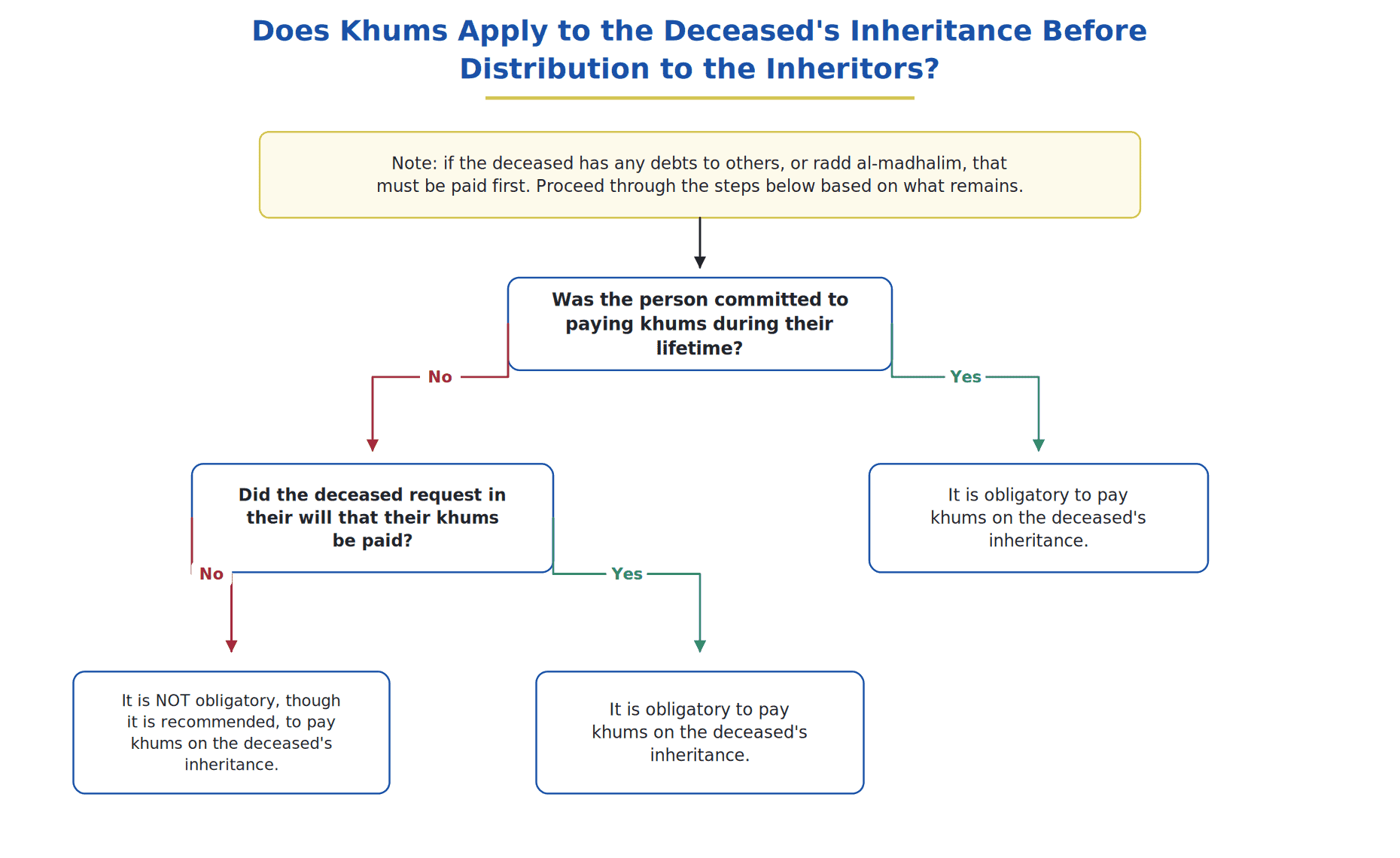
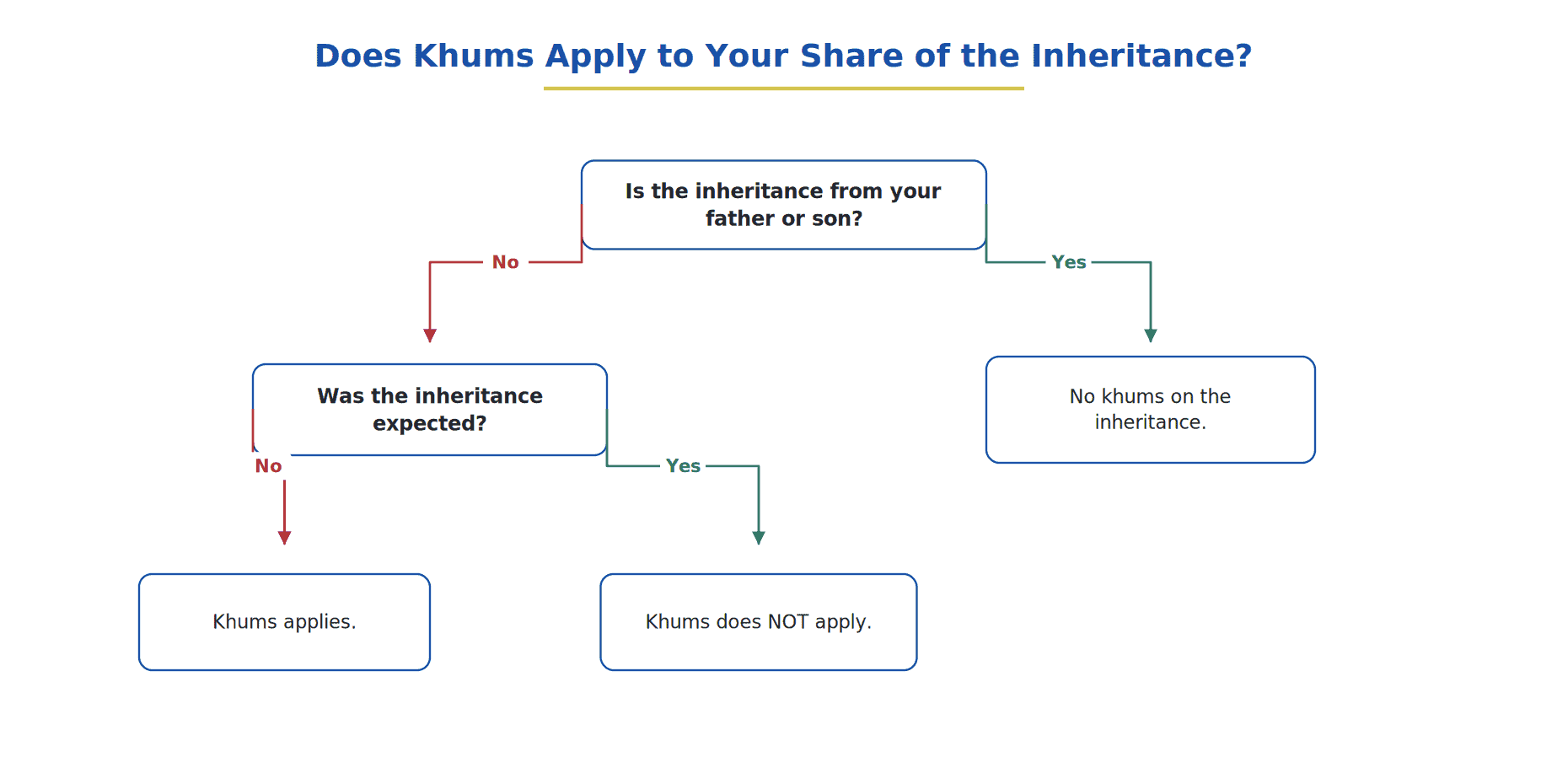
We mentioned previously in the chapter “What is Exempted from khums” that an anticipated inheritance, meaning inheritance that is expected, has no khums due on it, with a limited number of exceptions. Generally, if the deceased was someone who held themselves accountable and paid khums, and it is known that the deceased are liable for unpaid khums, then it is obligatory upon the heirs to pay the accumulated khums dues. In addition, it is obligatory to pay khums on the wealth that came to the deceased during what remained of their final year. This is because the day of the deceased’s death is considered the day of their final annual due date, no matter how short it may be.
On the other hand, if the deceased was someone who did not believe in the obligation of khums, or someone who did not hold themselves accountable and did not pay khums due to disobedience or neglect, or if the heir doubts whether the deceased was actually liable or doubts whether they were among those who paid khums or not, then it is not obligatory upon the heirs to clear the deceased’s liability of khums. Yet, it is good for them to pay khums as an act of righteousness toward the deceased and to lighten things for them on the day of their accounting before Allah Almighty.
If the deceased made a will to pay the khums, it is obligatory upon the heirs to pay the khums before dividing the principal of the inheritance, unless they restricted the bequest to paying the khums from the specific one-third (al-thulth), in which case it is paid from the one-third. If the khums was attached to a distinct asset, it is obligatory to pay the khums on its current actual value, and if the khums was attached as a general liability, then it is obligatory to pay the khums on the purchase price.
To simplify the subject and detail all of its cases and scenarios, we set it forth as follows. Inheritance is of two categories:
- Unanticipated: This refers to an inheritance whose acquisition is unexpected, such as if someone has a cousin who has offspring, and it is unanticipated that if they were to die that anything would come to them. Thus, if the cousin and their offspring pass away in an earthquake or a car collision, for example, and there is no heir other than them, and they inherit the wealth, then this is an unanticipated inheritance. If they do not spend it on their annual living expenses, then based on obligatory precaution, they must pay its khums upon their annual due date.
- Anticipated: This refers to what is expected to be inherited, as when children expect the inheritance of their father, mother, grandfather, or grandmother upon their death. Generally, there is no khums due on it except in a few cases, and there are multiple scenarios:
- If the deceased used to pay khums or the wealth was for living provisions/expenses, then there is no khums due on it.
- If the deceased did not pay khums after becoming liable, and:
- They were committed to pay the khums:
- In the inherited distinct assets: An example of this is if they (i.e., the deceased) purchased an orchard and a year passed over it, and then the orchard transferred to the heirs. It is obligatory upon the heirs to pay the khums, each from their own share after division.
- Regarding what they are liable for: An example of this is if they purchased a car over which a year passed, or it had been destroyed or gifted. It is obligatory upon the heirs to pay the khums from the principal of the estate, unless the deceased directed its payment from the one-third.
- The deceased was not committed to pay the khums: An example of this is if the deceased was someone who did not believe in the obligation of khums, or believed in it but did not pay it out of disobedience and stubbornness. Then, it is not obligatory at that point for an Ithna ‘Ashari heir to pay the khums, whether it is a general liability or attached to a distinct asset.
- The state of the deceased is unknown: Then khums is obligatory on it.
- They were committed to pay the khums:
- If it is unknown whether khums was obligatory upon the deceased or not: An example of this is if the mukallaf inherits property from their father and doubts whether their father had inherited from his father an anticipated inheritance or if it entered upon him through purchase. Khums is not obligatory on it. However, if the heir knows that it was from a benefit or profit and doubts whether the deceased used it for annual living expenses or not, then paying khums is obligatory at that point if they know that the deceased was committed to paying khums.
- If the deceased knew about the khums but there is doubt whether they paid it: It is obligatory to pay the khums if the deceased was committed to paying khums. If they were not committed to paying khums, then it is not obligatory upon the heir to pay it, whether the inheritance is a distinct asset or a general liability.
Question: When the jurist issues a fatwa stating that khums is not due on inheritance due to the refusal of the deceased to pay it out of disobedience or neglect, does that mean their liability is cleared?
Answer: Not at all. In cases where it is not obligatory upon the heir to pay khums on behalf of the deceased, this does not mean that the liability of the deceased is cleared. As it is said, “for the heir is the wholesome enjoyment, while upon the deceased is the sin.” However, out of righteousness toward parents and kindness to them, it is good for the heirs to pay khums on their behalf.
Question: In the event that the heirs wish to pay khums on behalf of the deceased, is it paid from the current actual value or from the purchase price?
Answer: If khums was due on the asset itself, such as if they purchased it from their current year’s profits, then it is obligatory to pay khums on the current actual value. If the khums was due as a general liability, such as if they purchased it with funds upon which a year had passed, then it is obligatory to pay the khums on the purchase price.