
Determining Income and the Khums Calculation Process
On this page
- Property Designated for Trade
- Wealth Designated for Savings and Investment
- Wealth Designated for Annual Living Expenses (ma’unah)
- Ruling on Growth (Increase/Rise)
- Rulings on Lands
- Debts/Loans
- Compensation/Offsetting Loss
- Doubt
The revenues constituting financial income that become the property of the mukallaf vary, and consequently, it is determined whether khums applies to them or not. This includes inheritance, gifts, and donations, trade, such as buying, selling, trading, and leasing, and investment and savings. Each of these has its own conditions and rulings. Here, we will address the general definition of each category and its consequences, and after that, we will cover the details of each one.
Property Designated for Trade
Definition: This refers to the wealth that one has set aside for making a profit, such as buying and selling shares, commodities, real estate, and other similar things. This also includes the supporting elements required for the person’s business, such as equipment, machinery, tools, and other resources.
The Ruling: It is obligatory to pay khums on it. If it consists of distinct assets, then it is obligatory to pay khums on their current actual value. There is no difference whether the wealth is directly in one’s possession or consists of other wealth (such as funds owed to them by a company or an entity, for example).
- If the remaining amount after paying khums is insufficient—by trading with it—to obtain a profit that satisfies the annual living expenses appropriate to one’s status, then khums is not obligatory at that point, unless the mukallaf is able to pay the khums gradually without facing hardship and difficulty. In that case, it is necessary for them to consult the religious authority (al-hakim al-shar’i) or his representative to allow them to be liable for the khums and repay it gradually.71
Question: A person whose annual living expenses are $100,000 purchases a plot of land for less than $100,000 in order to construct residential apartments on it, intending to lease them out for business and earn with them. Is it obligatory to pay khums on the land?
Answer: It is obligatory upon them to pay its khums. If they are unable to pay the khums, they must consult the religious authority (al-hakim al-shar’i) to allow them to be liable for the khums and repay it gradually.
Question: A person sells their commercial shop, which is the source of livelihood for themselves and their family, and they are looking to purchase another shop and have no other source of income to live on. Is paying khums obligatory upon them, knowing that if they pay khums on the amount, they will not be able to purchase another shop?
Answer: If khums had already been paid on the first shop, then paying khums is not obligatory except on the amount that exceeds the purchase price, in the event that an increase was realized and they did not spend it on their annual living expenses during the course of the year. If khums had not been paid on the original shop, it is obligatory to pay its khums immediately. If they are unable to do so, and the need for the money is critical, they must obtain permission from the religious authority (al-hakim al-shar’i) or his representative to allow them to be liable for the khums and repay it gradually.
Question: If the market value of wealth designated for trade (real estate, shares, etc.) rises and the mukallaf does not pay the khums, and then its market value drops, is the mukallaf religiously responsible for the khums of the shortfall?
Answer: Yes, they are responsible based on obligatory precaution. However, if they had consulted the religious authority to allow them to be liable for the khums, then they would not be required to pay the khums here.72
In further detail, we can say that the source of wealth designated for trade may be one of the following:
1. From an inheritance:
- Anticipated: There is no khums due on it, unless its value rises. In that case, the heir must pay khums on the increase, even if they do not sell it, as long as they are designating it for trade.73
- Unanticipated: It is obligatory to pay khums on the increase. As for the original wealth, it is obligatory to pay khums on it based on obligatory precaution if they do not spend it on their annual living expenses.
From loans:74
There is no khums due on a loan itself, but khums may apply to the profits that result from trading with it. Thus, if:
- The loans are unpaid: It is not obligatory to pay khums on the principal profits, unless there is an increase [from the principal profit], in which case khums is paid on the increase only.
- The loans are fully or partially repaid: For instance, if someone borrows $100,000 and purchases shares with it, and then repays the entire amount or a portion of it in monthly installments. Further, let us assume that the value of these shares rises to $200,000 at the annual khums due date—there are several possibilities here:
- They have repaid all the installments of the loan from:
- Their current year’s profits: then it is obligatory at that point to pay khums on the profits and the increase, meaning paying khums on the shares based on their current actual value, which is the entire $200,000.
- A past year’s profits on which khums had already been paid: then khums is paid on the increase only, meaning paying khums on $100,000.
- A past year’s profits on which khums had not been paid: then it is obligatory to pay khums on the funds used to repay the loan, in addition to paying khums on the increase, which is the entire $200,000.
- If the person has repaid some of the installments (e.g., $20,000) from:
- Their current year’s profits: it is obligatory upon them to pay khums on the amount of the repaid installments, which is $20,000, and pay khums on the realized increase, which is $100,000.
- The past year’s profits on which khums had already been paid: it is obligatory to pay khums on the increase only, which is $100,000.
- The past year’s profits on which khums had not been paid: it is obligatory to pay khums on the funds used to repay the loan, which is $20,000, and to pay khums on the realized increase, which is $100,000.
- They have repaid all the installments of the loan from:
- If the loans do not maintain their value—meaning they decrease below the purchase price. For instance, if one purchases shares for $100,000, repays half of the installments, and then their value drops to half:
- If they were repaid from the current year’s profits, where the outstanding loan balance equals the value of the distinct asset, then nothing is obligatory upon them.
- If they were repaid from past year’s profits on which khums had not been paid, then they must pay khums on what they repaid of the loans. So, if they paid $50,000, they must pay khums on $50,000.
3. From wealth in one’s possession through employment, trade, or a gift, and it was:
- From the current year’s profits: It is obligatory to pay khums on it immediately. If one does not pay khums immediately, it is obligatory to pay khums on it as well as on the increase in its market value if it occurs, and the same applies if the market value drops after an increase, based on obligatory precaution.
- From profits upon which a year has passed:
- And khums had already been paid on them:
- If the value of the distinct asset rises, then khums is obligatory on the increase (only).
- If the value of the distinct asset does not rise, then khums is not obligatory on it.
- And khums had not been paid on them: It is obligatory to pay khums on it, as well as on the increase in its market value if it occurs.
- And khums had already been paid on them:
Question: If someone hires themselves out for a specific job—such as transporting goods, maintaining real estate, landscaping a garden, or working as a babysitter, or something similar—and they receive the money in advance, and the annual khums due date arrives before the work begins, is khums obligatory on the received wages?
Answer: It is not obligatory upon them to pay the khums on the wages before performing the work.
Question: When renting a house or a car, the lessor usually requires an amount to guarantee coverage of any expected damage, and it remains as a security deposit with the lessor until the last day of the lease. If the annual khums due date arrives, is it obligatory [upon the lessee] to pay khums on it?
Answer: If it is an item on which khums has already been paid, or an item on which khums does not apply, such as an inheritance, a dowry (mahr), or a loan, then khums does not apply to it. Otherwise, khums is obligatory on it.
Wealth Designated for Savings and Investment
Definition: This refers to the wealth that the mukallaf owns but has not designated for trade. Rather, they seek to preserve its value from inflation, such as by purchasing land, gold bullion, or other similar items. Or, going beyond that, by investing it to benefit from its profits, such as by purchasing real estate and leasing it out, or purchasing shares in a company and utilizing its dividends.
The Ruling: It varies depending on the type/source of the wealth. If it is:
From an inheritance:
- Anticipated: Its ruling is that khums is not obligatory.75
- Unanticipated: Its ruling is that paying khums based on its market value is obligatory based on obligatory precaution.
From loans:
There is no khums due on a loan itself, but khums may apply to the profits that result from investing with it and after paying its installments. Thus, if:
- The loans are unpaid: Its ruling is that khums is not obligatory on it.
- The loans are fully or partially repaid: For instance, if someone borrows $100,000 and purchases real estate for investment with it, and pays the installments little by little, and the value of the real estate rises to $200,000 at the annual due date, then there are several possibilities here:
- If they have fully repaid the loan from:
- Their current year’s profits: then it is obligatory at that point to pay khums on the real estate based on its current actual value (meaning paying khums on the entire $200,000).
- A past year’s profits on which khums had already been paid: then there is no khums due on it.
- A past year’s profits on which khums had not been paid: then it is obligatory to pay khums on the funds used to repay the loan.
- If the person has repaid some of the installments (e.g., $20,000) from:
- Their current year’s profits: it is obligatory upon them to pay khums on the amount that corresponds proportionally to the repaid installments only, and nothing else.
- A past year’s profits on which khums had already been paid: then there is no khums due on it.
- A past year’s profits on which khums had not been paid: it is obligatory to pay khums on the funds used to repay the loan, and nothing else.
- If they have fully repaid the loan from:
From employment/trade/gift/donation:
For instance, if the mukallaf sets aside wealth from their monthly salary, receives a gift, funds from a business transaction or something similar, and it was:
- From their current year’s income: Its ruling is that it is obligatory to pay khums on its current actual value at the annual khums due date, whether the value of the property rose or dropped.
- From funds on which a year has passed and khums had already been paid on them: The ruling is that khums is not obligatory, unless they sell it and the value has risen, in which case they pay khums as part of the profits of the year of the sale.
- From funds on which a year has passed and khums had not been paid on it: The ruling is the obligation to pay khums on the capital only.
Question: If someone uses wealth on which khums has already been paid, or wealth on which khums does not apply, such as inheritance or a dowry (mahr), for example, to purchase a piece of land or gold bullion out of fear of cash devaluation and the currency being exposed to inflation, does khums become due on it?
Answer: There is no khums due on it, even if its value rises. On the other hand, khums becomes due if they sell it, specifically regarding the increase [in value] of the distinct asset like land or gold. However, regarding the increase resulting from inflation, the obligation to pay khums is jurisprudentially problematic (mahall ishkal), although based on obligatory precaution, it should have khums paid on it.
Wealth Designated for Annual Living Expenses (ma’unah)
Definition: Annual living expenses refer to the sum total of personal expenditures by which livelihood is sustained, such as food, drink, medical treatment, housing, clothing, and related matters for oneself and those one supports, such as a wife, children, and others (such as parents, guests, servants…). Or it may have a tangible equivalent, as in housing, a car, furniture, etc.
Ruling: It is necessary to determine its source, and then its ruling is determined as to whether khums applies to it or not. It falls into three categories:
From an inheritance:
- Anticipated: Its ruling is that khums is not obligatory.76
- Unanticipated: It is obligatory to pay khums on it based on its current actual value based on obligatory precaution, whether they used it or did not use it.
From loans:
There is no khums due on a loan itself, but the obligation of khums may apply to the remaining balance, and it may not apply, depending on the installments paid. Thus, if:
- The loans are unpaid: Its ruling is that khums is not obligatory on it.
- The loans are fully or partially repaid:
- And they used it for their living provisions before a year passed: Then khums is not obligatory, unless they sell it, in which case they pay khums on the increase out of the profits of the year of the sale.
- And they did not use it for their living expenses: Let us assume that a person purchases real estate for residence with a loan of $100,000, and pays the installments little by little, and subsequently the value of this residential real estate becomes $200,000 at the arrival of the annual due date, then there are several possibilities here:
- If they have fully repaid the loan from:
- Their current year’s profits, then there is no khums due on it.
- A past year’s profits on which khums had already been paid, then there is no khums due on it.
- A past year’s profits on which khums had not been paid, then it is obligatory to pay khums on the funds used to repay the loan, and nothing else.
- If the person has repaid some of the installments (e.g., $20,000) from:
- Their current year’s profits, it is obligatory upon them to pay khums on the amount of the paid installments (i.e., $20,000) only, and nothing else. So, if someone purchases real estate with a borrowed $100,000, for example, and then repays half of it, and the value of the real estate rises to $200,000 at the annual due date, then it is obligatory to pay khums on the $100,000.
- A past year’s profits on which khums had already been paid, then there is no khums due on it.
- A past year’s profits on which khums had not been paid, it is obligatory to pay khums on the funds used to pay the loan, and nothing else.
- If they have fully repaid the loan from:
From employment/trade/gift/donation:
For instance, if the mukallaf sets aside wealth from their monthly salary, receives a donation or gets funds from a business transaction or something similar, and it was:
- From their current year’s income:
- If it is out of items that do not decrease with use, and they used it, then there is no khums due on it, such as a residential house, furniture, and other such things.
- If it is out of items that decrease with use, then they pay khums on what remains based on the current actual value. This applies to the remainder of foodstuffs, clothing, and perfumes, if they have market value.
- From income upon which a year has passed, if:
- Khums had already been paid: The ruling is that khums is not obligatory, even if the value increases, unless they did not use it for living provisions and sold it, in which case they pay khums on the increase [in value] upon the annual due date.
- Khums had not been paid: The ruling is the obligation to pay khums on the actual funds [used to purchase their annual living provisions] immediately, whether the market value increases or does not.
It is appropriate here to mention some important matters:
If a mukallaf leases out their real estate for several years, for example, and receives its full rental income in advance, is khums obligatory on the entire rental income or on the rental income of their current year only?
Answer: The entire rental income is considered part of the profits of the year of the lease. It is within their right to deduct any depreciation that may affect the real estate’s value or its repair costs in the coming years. Likewise, it is permissible for them to deduct their first year’s annual living expenses, since they earn a living from the rent.
If a mukallaf leases out their real estate for several years but has not received the rent, what is the ruling on khums?
Answer: The ruling on debts that they are owed by people applies to it.77 Likewise, they deduct the amount of depreciation affecting the value of the real estate or what they spend on it for repairs.
If a mukallaf rents a house for their residence for several years and pays the rent in advance, is khums obligatory on what they paid for the future years’ rent, since it does not constitute their current year’s annual living expenses?
Answer: If they paid the rent from wealth that is free of khums, such as inherited property or property on which khums has fundamentally already been paid, then nothing is obligatory upon them. On the other hand, if they paid it from wealth upon which a year has passed and it was obligatory to pay its khums, then they must pay the khums on that amount. If they paid it from their current year’s income and it was surplus to their annual living expenses, it must have khums paid on it. If they paid it from loans, nothing is obligatory upon them.
Ruling on Growth (Increase/Rise)
Certain properties undergo an abundance that appears in different forms. Real estate like houses and lands, and commercial shops and orchards may experience a rise in prices from time to time. Trees and plants may bear fruit in the form of vegetables, fruits, legumes, and other things. Animals’ bodies may grow, leading to a rise in their value, or they may yield milk, eggs, and wool, for example, and likewise, they multiply, causing livestock wealth to grow, among many other examples and specific circumstances.
What is the ruling for khums with such growth, increases, or rises in value? Here are the details based on the type, nature, and status of the growth and increase:
- Separated increase: Chicken eggs, cow’s milk, palm offshoots, real estate rent, and similar things that are considered an increase separated from the item and were not spent on annual living expenses. Their ruling is the obligation to pay khums on them, since they are considered a profit/gain as long as they are not spent on the current year’s living expenses.
- Connected increase: Such as chicks growing up to become chickens, or a lamb growing to become a sheep, or palm offshoots becoming fruit-bearing palm trees, and similar things—whereby the size and weight of the animal result in an increase in market value according to the view of customary norms (‘urf). The ruling on this increase is:
- If it is part of one’s living expenses, then there is no khums due on the connected increase unless they sell it.
- If it is not part of one’s living expenses, then according to customary norms, if it is deemed an increase, it must have khums paid on it (e.g., chicks/small palm trees). If custom does not deem it an increase (e.g., grown chickens/mature palm trees), then there is no khums due on it.
- Increase in market value: For instance, commodities in the market are subject to price increases, or real estate rises in price… etc.
- If it is designated for trade, then it is obligatory to pay khums on it upon the annual due date, even if they do not sell it. Even if the original distinct asset is exempt from khums, such as an inheritance, for example, and they designated it for trade and an increase in its market value occurred, it is obligatory to pay khums on the increase upon the annual due date.
- If it is designated for investment and savings, such as if one owns a distinct asset of real estate and its price rises:
- Before the sale: Khums is not obligatory on it.
- After the sale:
- If the distinct asset was acquired by the mukallaf without having given anything in return for it:
If it is from something that is free of khums, like inheritance or dowry, then there is no khums due on it even if they sell it at an increased price.
If it is from something on which khums applies, such as a gift from a father to his child, for example, and they had paid its khums from other than the distinct asset itself: For example, a father gifts his child shares worth $10,000, so the child pays their khums from other funds and keeps the shares to benefit from them, and their value subsequently rises. As such, they own 4/5 of the shares by way of the gift and own 1/5 of the shares by way of [value] exchange (i.e., the portion of the shares on which khums was paid from other funds). Thus, khums is not obligatory on the increase in value with respect to the 4/5 of the shares owned by way of the gift, even if they sell them at an increased value. However, khums is obligatory upon the increased value of the 1/5 owned through exchange if they sell it because it is considered part of the current year’s profits. However, if they paid the khums from the distinct asset itself—meaning if they paid 20% of the shares themselves—then in that case, khums is not obligatory on the increase in value even if they sell at the increased value.
- If the distinct asset was acquired by the mukallaf by giving (i.e., in exchange for) something on which khums had already been paid, and an increase in value occurs, then at that point, khums is obligatory on the increase upon sale if they do not spend it on their annual living expenses.
- If the distinct asset was acquired by the mukallaf without having given anything in return for it:
Rulings on Lands
A mukallaf may own land in one way or another, through purchase, exchange, by way of inheritance, donation, or by another similar means. They may intend to trade or invest with it, or use it for their annual living expenses, for example. What is meant by lands here are those lands that are actually viable and developed, such as orchards, houses, factories, and other such things. As such, they are like other properties and distinct assets in that khums is obligatory on them. However, if the land is unviable (mayyitah), then khums does not apply to it unless it is made viable through cultivation, building, or at least by marking its boundaries/fencing, for instance. Otherwise, its mere purchase and sale do not establish a [personal] right for the person acquiring it. Therefore, for someone who owns unviable land as a grant from the state, or through purchase from a company or a person, for instance, the transaction is invalid and does not establish a right for them, and it is obligatory upon them to pay khums on the amount they pay for it. If unviable land is made viable, the one who made it viable owns it according to shari’a, and whatever applies to any other distinct assets applies to it. Thus, if the annual khums due date arrives and it is surplus to their annual living expenses, then they pay its khums based on its current actual value.
The discussion here relates to viable land only. The details according to the differing scenarios are as follows:
Commercial Lands
Initially, it is necessary to know the source of the commercial land. If it is:
From an inheritance:
- Anticipated: It is obligatory upon the heir to pay khums on the increase, even if they do not sell it.
- Unanticipated: It is obligatory to pay khums on the increase. As for the original wealth [used to purchase the land], it is obligatory to pay khums on it based on obligatory precaution.
From loans:
There is no khums due on a loan itself, but khums may apply to lands depending on the scenarios. Thus, if:
- The loans are unpaid: It is not obligatory to pay khums on the original wealth [used to purchase the land], unless there is an increase, in which case khums is paid on the increase only.
- The loans are fully or partially repaid: For instance, if someone borrows $100,000 and purchases an orchard with it, and repays the amount or a portion of it in monthly installments. Let us assume that the value of this orchard rises to $200,000 at the annual khums due date, then there are several possibilities here:
- If they have fully repaid the loan from:
- Their current year’s profits: then it is obligatory at that point to pay khums on the land based on its current actual value (i.e., paying khums on the entire $200,000).
- A past year’s profits on which khums has already been paid: then khums is paid on the increase only (i.e., paying khums on the $100,000 only).
- A past year’s profits on which khums has not been paid: then it is obligatory to pay khums on the funds used to repay the loan, in addition to paying khums on the increase (i.e., paying khums on the entire $200,000).
- If the person has repaid some of the installments (for example, $20,000) from:
- Their current year’s profits: it is obligatory upon them to pay khums on the amount of the repaid installments (i.e., $20,000), and the realized increase (i.e., $100,000).
- A past year’s profits on which khums has already been paid: it is obligatory to pay khums on the increase only.
- A past year’s profits on which khums has not been paid: it is obligatory to pay khums on the funds used to repay the loan, in addition to paying khums on the increase.
- If they have fully repaid the loan from:
From employment/trade/donation:
- And it is from their current year’s profits: It is obligatory to pay khums on the property based on its current actual value upon the arrival of the annual khums due date.
- And it was from profits upon which a year has passed and they are:
- Funds on which khums has already been paid: There is no khums due on it, unless its value rises, even if they do not sell it.
- Funds on which khums has not been paid: It is obligatory to pay khums on it according to its market value.
Investment Lands
Initially, it is necessary to know the source of the investment land. If it is:
From an inheritance:
- Anticipated: Khums is not obligatory on it.
- Unanticipated: Paying khums is obligatory based on obligatory precaution.
From loans:
- Fully or partially repaid: Example: If someone borrows $100,000 and purchases an orchard with it. They repay the amount or a portion of it in monthly installments, and let us assume that the value of this orchard rises to $200,000 at the annual khums due date, there are several possibilities here:
- If the person has fully repaid the loan:
- From their current year’s profits: then it is obligatory at that point to pay khums on the orchard based on its current actual value if they sell it (i.e., paying khums on the entire $200,000).
- From a past year’s profits on which khums has already been paid: then there is no khums due on it, unless they sell it, in which case they pay khums on the increase only (i.e., paying khums on the $100,000).
- From a past year’s profits on which khums has not been paid: then it is obligatory to pay khums on the funds used to repay the loan, and they pay khums on the increase if they sell it.
- If the person has repaid some of the installments (e.g., $20,000):
- From their current year’s profits: it is obligatory upon them to pay khums on the amount of the repaid installments (i.e., $20,000).
- From a past year’s profits on which khums has already been paid: then there is no khums due on it.
- From a past year’s profits on which khums has not been paid: it is obligatory to pay khums on the funds used to repay the loan, and none other.
- If the person has repaid some of the installments (e.g., $20,000):
- Unpaid: Paying khums is not obligatory.
From employment/trade/donation:
- And it was from their current year’s profits: It is obligatory to pay khums on the property based on its current actual value upon the arrival of the annual khums due date.
- And it was from profits upon which a year has passed and they are:
- Funds on which khums has already been paid: There is no khums due on it, whether its value increased or not, unless they sell it, in which case khums applies to the increase only.
- Funds on which khums has not been paid: It is obligatory to pay khums on that upon which khums has become due. As for the increase, they do not pay khums on it unless they sell it and do not put it toward their annual living expenses.
Lands Used for Annual Living Expenses
First of all, it is necessary to know the source of the land applied toward annual living provisions, such as a residential house, for example. If it is:
From an inheritance:
- Anticipated: Khums is not obligatory on it.
- Unanticipated: If they use it for their living provisions, then there is no khums due on it. If they do not use it for their living provisions, then based on obligatory precaution, it must have khums paid on it according to its market value.
From loans:
- Fully or partially repaid: If they use it for their annual living provisions, then there is no khums due on it, unless they sell it, in which case they pay khums on the increase. If they do not use it, then there are several possibilities. Let us assume that the mukallaf purchases land for the purpose of residence with a loan of $100,000, and then repays the borrowed amount or a portion of it in monthly installments, and let us assume that the land increases in value to $200,000:
- If they repay all the installments:
- From their current year’s profits: paying khums is not obligatory since they used it in their living provisions.
- From a past year’s profits on which khums has already been paid: then there is no khums due on it.
- From a past year’s profits on which khums has not been paid: then khums is obligatory on it.
- If the person repays some of the installments (e.g., $20,000):
- From their current year’s profits: paying khums is not obligatory, since they used it in their living provisions.
- From a past year’s profits on which khums has already been paid: then there is no khums due on it.
- From a past year’s profits on which khums has not been paid: then it is obligatory to pay khums on the funds used to repay the loan, and nothing else.
- If they repay all the installments:
- Unpaid: Paying khums is not obligatory.
From employment/trade/donation:
- And it is from their current year’s profits: If they use it, then there is no khums due on it. If they do not use it, then it is obligatory to pay khums based on the market value.
- And it was from profits upon which a year has passed and they are:
- Funds on which khums has already been paid: Then there is no khums due on it, no matter how much it rises, unless they sell the distinct asset for an increased value and do not spend it on annual living expenses, and the annual due date arrives, then, in that case, they pay khums on the increase.
- Funds on which khums has not been paid: It is obligatory to pay khums on the original funds [used to purchase the land] only, even if the market value increases.
Debts/Loans
A debt (dayn) is the establishment of a right for a person as a liability upon another person as a result of a transaction, whereas a loan (qard) is taking wealth from another for a period of time on the condition that they return it when they are able to do so. Thus, every loan is a debt, but not every debt is a loan. The one who owns the wealth is called “the creditor” (al-da’in) and the one who owes the wealth is called “the debtor” (al-madyun). Likewise, the one who gave the property is the “lender” (muqrid) and the one who owes the loan is called the “borrower” (muqtarid).
Many think that whoever owes a debt or loan is not obligated to pay khums as long as they are a debtor or borrower. This is an incorrect perception. The correct view is that a debt does not necessarily prevent khums from becoming due on new profits. Generally, there are several scenarios for debts and loans and the situation of the debtor or borrower, which we set forth according to the following detail:
Debts/Loans Owed to the mukallaf by Others
Lending to believers is among the highly emphasized recommended acts, especially to those among them who are in need. Conversely, borrowing is makruh (disliked) in the absence of need, and its dislike lessens with need. A debt and lending can be in one of two forms:
- It is from the revenues of a previous year, and the wealth:
- Has khums already paid on it: There is no khums due on it.
- Does not have khums paid from it: It is obligatory to pay its khums before lending it. If they do not pay its khums, and they were:
- Able to collect it: It is obligatory to pay its khums.
- Unable to collect it: Then the mukallaf has a choice between two options:
- To wait until they collect the debt, and once they receive it, they pay its khums immediately.
- To estimate the financial value of the loan and pay its khums.
- It is from the revenues of the current year, and they:
- Know that the time for its collection goes past their annual khums due date: It is obligatory to pay its khums.
- Do not know whether the time for its collection will go past their annual khums due date, and their annual khums due date arrives. Thus, if they are:
- Able to collect it: It is obligatory to pay its khums.
- Unable to collect it: Then the mukallaf has a choice between two options:
- To wait until they collect the debt, and once they receive it, they pay its khums immediately.
- To estimate the financial value of the loan and pay its khums.
Debts/Loans Owed by the mukallaf to Others
This scenario is the most common and predominant case, and it is a challenging matter for many people these days. Before entering into the details of this type of debt and when khums attaches to it and when it does not, it is necessary to point out some important points:
- If someone borrows wealth and does not spend it on anything, and it remains with them for a year or more, for example, then khums does not apply to it because it is property that does not belong to them, but rather, is the property of the creditor or lender.
- The legitimate Islamic loan (al-qard al-shar’i): It means the loan that is being borrowed from a Muslim person or a Muslim entity whose owner is known, and that it is not usurious (interest-based). The loan granted by the state or by non-Islamic banks is not considered an Islamic loan to which the Islamic legal matters mentioned here apply.78 It is not permissible for a believer to borrow with interest (riba), even if it is from a non-Muslim entity, except by way of istinqadh (expropriation/safeguarding).79
Question: Is it possible for the mukallaf to change their intention from a loan to istinqadh in order to validate their transaction? And does it differ whether they were aware of the ruling or ignorant of it? And what is required of them if they were aware of the ruling?
Answer: The loan remains as it is. If they were ignorant, there is no sin upon them; but if they were aware, they must seek forgiveness and repent.
- Continuous living expenses: The portion of profits that may be exempted [from the calculation of khums] must be for the repayment of loans towards continuous living expenses. This refers to everything a person spends continuously in their daily life, such as their need and use of a house, car, furniture, and similar things. As for marriage expenses, tuition costs, and other such things, which are spent once, they are non-continuous living expenses.
Question: What about university student loans that may last for many years until they are fully repaid?
Answer: They are not considered continuous living expenses.
- A debt that decreases annually by virtue of paying installments over time. Therefore, only the remaining or outstanding portion is exempt and not the entire debt.
After clarifying these points, we say that if a legitimate Islamic loan is due upon a mukallaf and they wish to know whether they can deduct it from their profits or not, it is necessary at that point to know the details in terms of whether the loan has a tangible corresponding asset—such as if a house, a car, or furniture was purchased with it, for example—or if it was spoiled, lost, or wasted and no longer has a corresponding asset? Was it for living expenses or for purposes other than living expenses, like trade and investment? Is the borrower or debtor a person who has an occupation that they practice and has a known annual khums due date, or are they a person without an occupation? Do they repay the debts/loans from their current year’s profits or previous years’ profits? The details are according to the following order:
Repayment of the Debt/Loan from Past Years’ Profits
If the debt or loan:
- Has something present for it, such as a house, car, or furniture, and:
- It is for annual living provisions, and they intend to repay the loan:
- If they have an occupation (meaning they have a known annual khums due date) and the profit with which they wish to repay the debt or loan was:
- From that same khums year: then they may deduct the loan from the profits, even if it is delayed.
- Not from that same khums year: then they do not have the right to deduct the khums from the profits unless they pay khums first.
- If they do not have an occupation, then if the profit was:
- Contemporaneous with the expenditure of the debt on provisions (i.e., it was present when they borrowed), then paying off the debt is considered an expense for the following year. Thus, there is no khums due on it.
- Not present at the time of borrowing (i.e., they borrowed, then purchased, then acquired the profit) and they did not utilize the profit until the year passed, and then they wished to repay the debt, then they do not have the right to count it (i.e., the profit) toward the debt; rather, it must have khums paid on it first.
- If they have an occupation (meaning they have a known annual khums due date) and the profit with which they wish to repay the debt or loan was:
- It is not for living provisions, such as if it was for trade or investment, then they do not have the right to exempt the loan from the profits, and khums must be paid according to the market value at the annual khums due date.
- It is for annual living provisions, and they intend to repay the loan:
- Does not have something present for it, such as if the real estate was destroyed, or the car was wrecked, or they put it toward food, clothing or furniture and it was consumed, for example, and:
- It was for annual living provisions:
- If they have an occupation (meaning they have a known annual khums due date) and the profit was:
- From that same khums year: then they may deduct the loan from the profits, even if it is delayed.
- Not from that same khums year: then they do not have the right to deduct the khums from the profits unless they pay khums first.
- If they do not have an occupation, and the profit was:
- Contemporaneous with the spending of the debt on living expenses—meaning it was present when they borrowed—then the repayment of the debt is considered part of the subsequent year’s living expenses, and no khums is due on it.
- Not present at the time of borrowing (i.e., they borrowed, then purchased, then acquired the profit) and they did not utilize the profit until a year passed, and they wished to repay the debt, then they do not have the right to count it toward the debt; rather, it must have khums paid on it first.
- If they have an occupation (meaning they have a known annual khums due date) and the profit was:
- It was not for living expenses, such as if it was for trade or investment, then it is obligatory to pay khums on the profits, and they do not deduct the loan from them.
- It was for annual living provisions:
Repayment of the Debt/Loan from Current Year’s Profits
If the debt or loan:
- Has something present for it, such as a house, car, or furniture, for example, and:
- It was for annual living provisions, such as if they reside in the house and use the car and furniture—and they wish to repay the loan, then it is not obligatory to pay khums on the installments that are being repaid.
- It was not for living provisions, such as if it was for trade or investment, then they do not have the right to deduct the loan from the profits, and khums must be paid. Two options are available and they may choose one of them:
- Paying khums on the profits with which they wish to repay the installments.
- Paying khums of the profits on the annual due date, so that the distinct asset purchased with the loan becomes part of the current year’s profits, and they pay khums on it according to its market value.
- Does not have something present for it, such as if the real estate was destroyed, or the car was wrecked, or they put it toward food, clothing, or furniture and it was consumed, for example, then khums does not apply on it, whether it was for living provisions or not.
Additional important matters:
If someone borrows and purchases something for purposes other than annual living provisions, like trade, for example, then khums is not obligatory on it unless they have paid loan installments from it, in which case they pay khums on the amount they paid. Example: If someone purchases a car for $30,000 with a loan in order to earn a living with it, and upon the arrival of the annual due date they have paid $10,000 of the loan. Additionally, the value of the car drops to $20,000 due to usage and the passage of time. In such a case, nothing is obligatory upon them except to pay khums on the repaid proportion of the loan according to the car’s market value – the ratio of the paid installments to the loan is 1/3. As such, 1/3 of the car’s current market value is $6,666, which is the amount that must be paid, not $10,000.
What about the interest that the lender may impose on the borrower? Answer: Usury (riba) is haram. However, if the borrower is compelled and required to pay the interest as a result of laws or the requirements of the loan system, then they must consider it part of the expenditures of annual living expenses, and not part of the loan. Based on the example above, if in the $10,000 repaid installments there is a portion of interest, then it must not be counted as a deduction from the actual value of the car.
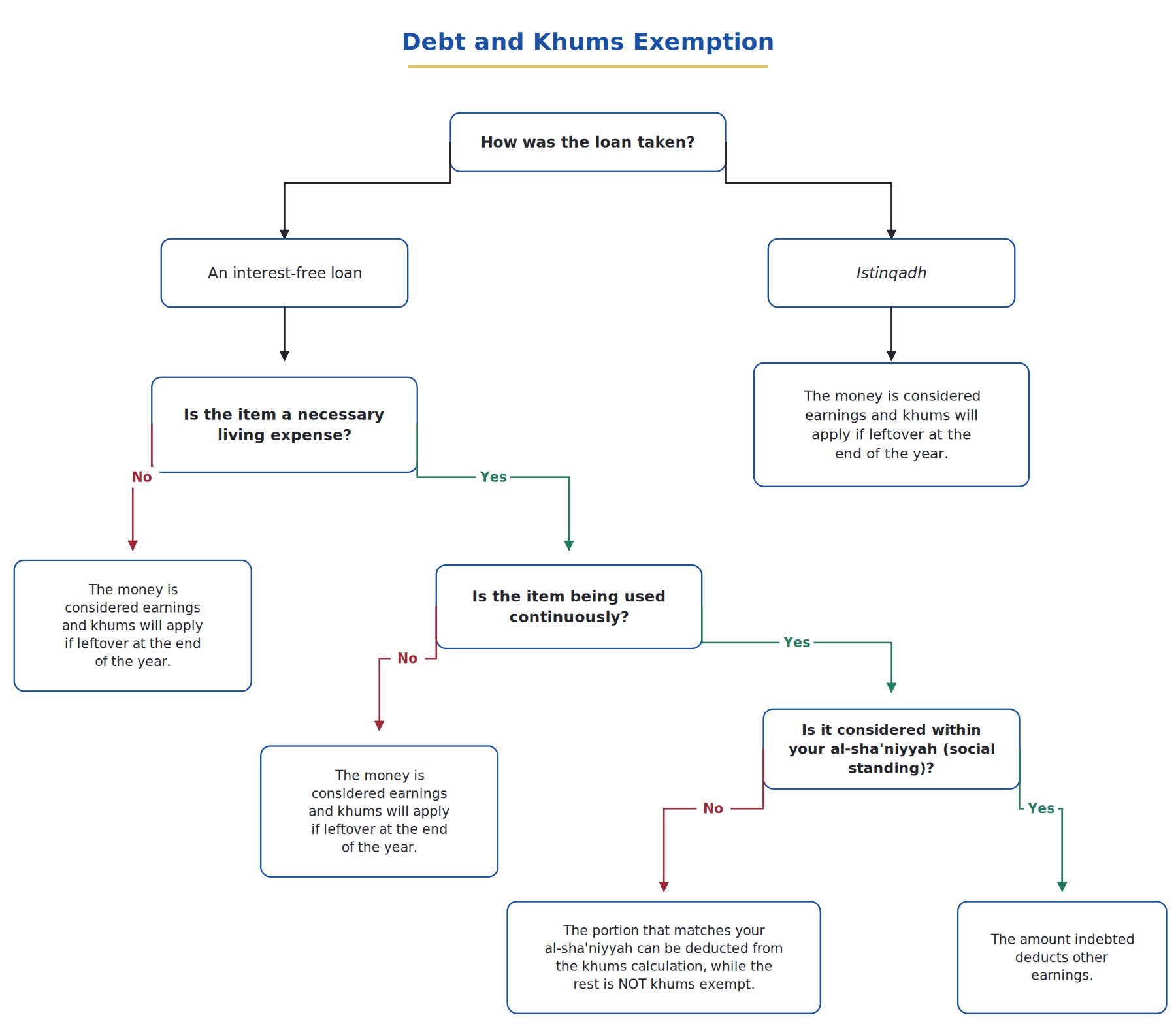
If someone borrows money and purchases something with it for their annual living provisions, such as a car, house, computer, and other similar things, then it is within the mukallaf’s right to deduct this debt from the income. Thus, if there is a debt of $100,000 upon the mukallaf and their income is $150,000, then they pay khums on the $50,000 only. On the other hand, if their income is $70,000, for example, then khums is not obligatory upon them because their income is less than the debt they are liable for.
If someone borrows an amount of money and uses it for a house for their annual living provisions, and not for trade, luxury travel, or investment, and the loan continues with them for years, does it exempt them from khums even if they profit? Answer: If the same conditions mentioned in the question apply, then yes, it is permissible. However, attention must be paid to the fact that what is exempt is the remaining or outstanding portion of the debt (and not the entire debt), and the installments are exempt, but not the interest resulting from them, and this applies for the remaining years.
Example: If someone borrows $10,000 to purchase a car, and the total installments they repaid in the first year are $1,000, for example. And their profit in this year (i.e., in which they took the debt) is $10,000 as well, then $9,000 is exempted from the khums at that point since it is equivalent to the debt which they have not repaid, and they pay khums on the remainder, which is $1,000. Thus, the khums obligatory upon them in the first year is $200 only. If they profit $10,000 in the second year as well, it is natural that they will have paid another $1,000 in installments; so they deduct the remaining debt, which is $8,000, from the second year’s living expenses, and pay khums on $2,000. Therefore, the khums that is obligatory upon them to pay in the second year is $400 only, and so on. The following flowchart illustrates this:
Compensation/Offsetting Loss
It is well known that property (cash or distinct assets) on which khums has already been paid is not subject to khums a second time, even if it remains for years. Thus, is it permissible to offset a loss by spending the wealth on which khums has already been paid on annual living expenses, or if they have losses in business and then offset it from new profits? There are details, and each is according to their specific situation.
Offsetting in Personal Annual Living Expenses:
If the mukallaf:
- Has an occupation, employment, or work from which they earn a living, like an employee or a merchant, then it is permissible for them to place the new profit in place of what they spent from the wealth on which khums had already been paid, even if acquisition of the new profit is delayed, as long as it is within a single year. Thus, if their annual khums due date is the beginning of the month of Rabi’ al-Awwal, and they spend their wealth on which khums has already been paid in the month of Rajab, and then profited in the month of Shawwal, they still retain the right to compensate or offset.
- Does not have an occupation, employment, or work from which they earn a living, like a student, housewife, or retiree, for example, then if the profit was contemporaneous with the spending on living expenses from wealth on which khums has already been paid, meaning that the new profit was present at the time of spending from that wealth, then it is permissible for them to compensate or offset. However, if they spent the funds on which khums has already been paid first, and subsequently acquired the profit, then it is not permissible for them to compensate/offset.
A person has an amount totaling $20,000 from the previous year on which khums has already been paid. They spend $10,000 from it on their living expenses for the subsequent year, and earn a profit of $10,000 during the current year. Is it permissible for them to retain the new profit and offset it from the spent wealth on which khums has already been paid? Answer: If they have employment, work, or trade from which they earn a living, and it is in that same khums year, then yes, it is permissible for them to offset the amount spent from the wealth on which khums has already been paid out of the profits, so they do not pay khums on the aforementioned profit. If they do not have employment or trade from which they earn a living, it is permissible for them to offset what was spent if the profit was acquired during the course of spending that wealth. However, if the profit is delayed (i.e., acquired after spending the wealth on which khums has already been paid), then it is not permissible for them to offset what they spent from the wealth on which khums had already been paid.
If the car they use for their annual living provisions is damaged, or their house is destroyed by an earthquake or flood, for example, is it permissible to offset this destruction from the profits at the end of the year? Answer: Yes, it is permissible if it is from their profits during the course of the year.
Does the mukallaf have the right to offset a loss from distinct assets on which khums has already been paid, such as foodstuffs, for example, or other such items, and they possess a market value? Answer: Yes, they estimate their value and offset it from the current year’s income.
Offsetting Business Expenses
If a merchant possesses $100,000 on which khums has already been paid, and they trade with it and lose $50,000 from it, but also profit $50,000, then the process of offsetting must be considered based on these three scenarios:
- The loss is from one year and the profit is from another year. For this condition it is obligatory upon them to pay khums on all the profits.
- The profit and loss both occurred within a single year, meaning the same khums year, and they possess a single type of trade or earning. For this condition it is permissible for them to offset the loss, even if the profit is delayed.
- The profit and loss occurred within a single year, but the mukallaf possesses diverse sources of livelihood and they have set a different annual due date for each source. For example, they are an employee as well as a merchant, or a laborer in a factory as well as a taxi driver, or contracted with a company for a fixed income as well as trading in shares. If they acquire a profit in one trade and a loss in another, then it is not permissible for them to offset the loss, and they must pay khums on all the profits based on obligatory precaution. On the other hand, it is permissible for them to offset the loss that occurred if it is all considered a single trade with a single capital, a single set of accounts, and a single annual khums due date for all of it.
Observations:
- If the trades are multiple and they all constitute the backbone of the person’s livelihood, such as being an employee with a modest salary and [simultaneously] working as a taxi driver, and by the sum of income from them they cover their annual living expenses, then it is not permissible for them to offset the loss of one by the other based on obligatory precaution.
- The taxes imposed by the state on a citizen are considered part of the expenses, whether living or business and work expenses; therefore, they cannot under any circumstance be deducted from the khums.
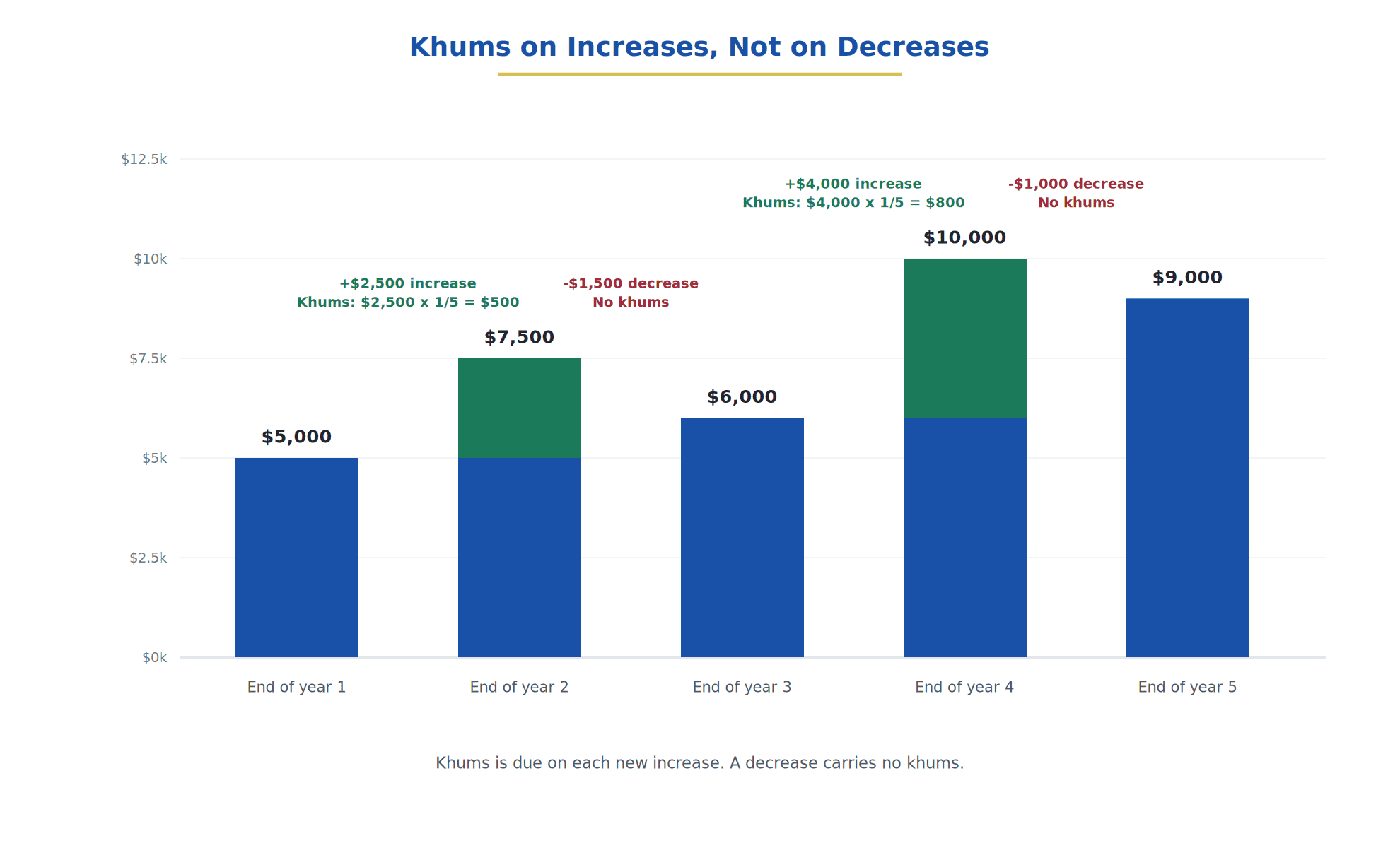
- If the mukallaf pays the khums on their wealth and its market value subsequently drops, is it permissible for them to retain their khums-paid balance as its current value and offset the drop from the current year’s profits? Meaning, if the annual khums due date was the beginning of the month of Rabi’ al-Awwal, for example, and in Rabi’ al-Awwal of the year 1430 they paid the khums on their wealth and ended up with $50,000 (on which khums had been paid), so they purchased shares with it. Then in the month of Shawwal of that same year, the value of the shares dropped to $20,000 and continued like that until the end of the khums year so that when the next annual due date arrived in Rabi’ al-Awwal 1431, $30,000 had dropped from the value of the shares. Subsequently, they found they had new profits worth $30,000. So, is their balance on which khums had been paid for the previous year retained as it was, thereby offsetting the deficit in the shares’ value by the new profit, so that khums is not obligatory on this [new] profit? Or must they pay the khums on these profits completely and not offset that deficit?
Answer: If the wealth on which khums had been paid was designated for trade, then the rule of offsetting applies. But if it was for annual living expenses or investment, and its value decreased, then the deficit is not offset. Rather, it is obligatory to pay the khums on the full profits.
- Whatever is destroyed of wealth or property on which khums has already been paid for other than annual living provisions. Such as if a person’s jewelry is stolen, their home furniture is burned, or they possess real estate designated for investment and its market value drops. Then, it is not offset from the new profits, rather, it is obligatory to pay khums on the entirety of the new profits without exempting the destroyed asset(s). On the other hand, they have the right to offset the loss or the drop in value if they had designated it for trade within their khums year (as explained previously).
- The deferred dowry (al-mahr al-mu’ajjal) is considered a debt as a liability upon the husband and it is considered part of the living expense of the year of the marriage. Consequently, it is permissible for the husband to deduct it from the current year’s profits if he has an occupation or employment from which he earns a living. If he does not have employment or an occupation from which he earns a living, then it is permissible for him to deduct it from the current year’s profits if they were realized at the time of the dowry’s designation, and not after it.
Doubt
A state of doubt may affect the mukallaf in one of the cases that have been mentioned, especially if they do not manage their accounts precisely or do not record details as required. Thus, a doubt occurs, such as concerning the determination of their annual due date, the profits, the expenditures, the losses, or other matters. We draw attention to the most important points in this area to treat what is doubted:
- If someone doubts whether wealth in their possession came into their ownership through an anticipated inheritance or a dowry, or they owned it through acquisition (hiyazah), trade, or a gift, then khums is not obligatory on it.
- If someone doubts regarding wealth in their possession at the end of the year, whether it is this year’s profits or the profits of previous years, and it is their habit to pay khums, or if they purchased something and did not use it for their annual living provisions and doubted whether they purchased it with wealth on which khums had already been paid or wealth on which it had not, then it is necessary to exercise precaution by paying the khums.
- If someone doubts whether they used their wealth (cash or distinct asset) for their annual living provisions/expenses or did not use it, and the annual due date arrives, then it is obligatory upon them to pay its khums.
- If someone possesses distinct assets on which khums had already been paid and their value rises, but they doubt whether they were designated for trade or for investment and acquisition, then it is not obligatory upon them to pay khums on the increase as long as the doubt exists.
- If someone possesses wealth on which there is no khums due which is designated for trade, and its value rises, but they doubt the manner in which it came into their ownership, whether it was through purchase or inheritance, then it is obligatory upon them to pay khums on the increase only.
- If someone doubts whether the profit and loss occurred within a single year or two years, then based on obligatory precaution, they must reach a settlement (musalahah) with the religious authority.
- If the mukallaf has a debt for annual living expenses and they wish to repay it from profits upon which a year has passed, then it is permissible for them if the profit was contemporaneous with the debt and they were among those who have no occupation or employment. On the other hand, if the mukallaf doubts whether the profit preceded or followed the debt, then it is obligatory to pay its khums first and then repay their debt with it.
- If the mukallaf has an occupation or employment and they have a debt, and they wish to repay the debt from profits upon which a year has passed, then it is permissible for them to do so if it is from a single year. However, if the mukallaf doubts whether it is from a single year, then it is obligatory upon them to pay the khums first and then repay the debt with it.
- If the mukallaf has wealth or property on which khums has become due, but it was destroyed and they do not remember its value, then it is obligatory to pay khums on its lowest probable value.
- This is referred to as mudawara and its definition and examples will be provided later. ↩
- This is one of the benefits of mudawara process, which will be discussed later. ↩
- Regardless of whether the deceased person had paid khums on their property before their death or not. This is a separate issue that will be discussed in the section on paying khums on inheritance. ↩
- We mentioned the general overview regarding loans in the introduction of this book, and the details and examples will follow later. ↩
- With the exception of certain cases that will be discussed in the section on the khums of inheritance. ↩
- With the exception of certain cases that will be discussed in the section on the khums of inheritance. ↩
- Refer to the section on debts and the details mentioned therein. ↩
- A debt must be fulfilled in accordance with shari’a, adhering to the terms of the transaction and the agreement between the creditor and the debtor; failure to comply with these terms is not permissible. ↩
- Istinqadh (Recovery): A jurisprudential term referring to the acquisition of funds from a non-Muslim entity—such as a bank—even if the transaction involves an agreement or obligations requiring the repayment of the principal amount along with interest. ↩