
What Is Subject to Khums?
On this page
- Things that are exempt from khums
- How khums applies to wealth
- The religious consequence regarding property on which khums has become due
- Upon whom is khums obligatory?
- Determining Annual khums Due Date
- Annual Living Provisions/Expenses (ma’unah)
It is stipulated that what is subject to khums must be owned.
Khums is not due on anything the person does not own, let alone what belongs to someone else, such as a child, spouse, sibling, or any other person.
Likewise, there is no khums on whatever one has been permitted to use or dispose of for any reason whatsoever. Thus, if a person takes possession of a friend’s or relative’s orchard, car, real estate, or computer, or anything that could potentially be subject to khums, and their khums year turns while they possess it, it is not obligatory upon the possessor to pay khums on what they possess, because it is not their property.
In other words, the following categories of property may be owned by a person and may become subject to khums if they exceed his annual living expenses (mu’nah):
- Gifts, Prizes, and Grants:
Anything obtained through gifts, awards, prizes, bequests, or grants and scholarships provided by the state, organizations, institutions or even individuals.
Wealth obtained through the Imam’s share of khums: If a student of religious studies receives a portion of the Imam’s share (sahm al-Imam) and spends it, for example, on books but does not actually use them for study during that year, then khums must be paid on the current value of those books.
Sadaqat: Sadaqat collected in a box at home or the workplace to be transferred to the poor later. The mere separating and placing of it inside the sadaqa box does not mean it has ceased to be the property of the donor; therefore, if their annual khums due date arrives, it is obligatory upon them to pay khums on it. Yes, if the box belongs to a specific entity—such as charitable organization concerned with caring for the poor—in a manner that renders them an authorized agent on behalf of the poor to receive it, or authorized by the hakim al-shar’i (religious authority) to receive it, then it has ceased to be the property of the donor, and khums is not obligatory upon it.
- Unanticipated inheritance59:
If a person inherits under unusual circumstances, such as an uncle inheriting from a deceased nephew, or an older brother inheriting from a younger sibling. In such cases, khums should be paid on that inheritance, as a matter of obligatory precaution.
- Acquisition from business trade, possession, rent, or employment.
This has many details, which will form the main focus of this book’s content to follow. It includes:
- Cases requiring the immediate payment of khums, once the mukallaf knows that the wealth is in excess of their annual living expenses.
- If the social standing (sha’niyyah)60 of the mukallaf decreases, then it becomes obligatory to pay khums on whatever exceeds it. An example of this is someone who was supporting himself, his wife, and five children, and had provided a spacious residence that accommodated them all comfortably. Then they grew up and became independent, leaving the parents content with a house of one or two bedrooms. Here, it is mandatory to pay khums on whatever exceeds their current living expenses (ma’unah).
Another example is if a person held a position of a high and exceptional rank that required using a luxury car, servants, and guards, but after retiring and moving to a retirees’ residence, no longer needed any of that—their social standing (sha’niyyah) changed, and consequently, their living expenses decreased. Thus, whatever exceeds that must have khums paid upon it.
- If the mukallaf intends to waste their wealth, or spend it on something forbidden, or on extravagance, or squandering, then they must pay khums of it immediately. For example, if they put their money into gambling, or to buy impure items, or squander their money on trivialities at prohibited parties, or they are extravagant and wasteful in buying things that are unnecessary or have no real value except for showing off and so on—things that are either forbidden by Islamic law or reprehensible according to reason.
- When halal wealth gets mixed with haram wealth, paying khums from it purifies it.
First and foremost, it must be noted that if the exact amount of the haram wealth and its rightful owner are known, then it must be returned to its owner by mutual agreement. If this is not possible, then several cases arise:
- If the mixing of wealth is such that it is not possible to know/distinguish which part is haram, nor who owns it, nor is it known whether the haram portion is less than, equal to, or greater than one-fifth of the mixed wealth, then the entire amount becomes purified by paying khums from it. However, based on obligatory precaution, the mukallaf must make a general intention (niyyah mutlaqah), which is not specified as khums nor sadaqa, and pay the amount on behalf of the rightful owner to those entitled to receive it. Based on this, the person must give half of this amount to the entitled needy among the Hashemites, and the other half to meet the essential needs of the needy believers. In both of these cases of distribution, one must (as an obligatory precaution) refer to the hakim al-shar‘i (religious authority).
- If the amount of haram wealth is known, whether it is less than, equal to, or greater than one-fifth of the total wealth that is mixed with haram, but the owner is not known, then it must be given on the owner’s behalf to the needy who are entitled to receive sadaqa. Moreover, permission from the hakim al-shar‘i (religious authority) should be obtained before doing so, based on obligatory precaution.
- If it is not possible to distinguish the haram portion from halal, but the mukallaf knows that the haram portion is less than one-fifth of the total amount that is mixed, even generally, but they do not know its owner, and the mixing did not occur due to the mukallaf’s dereliction (i.e., it occurred inadvertently or due to misunderstanding), then it suffices to give it as sadaqa to the poor who are eligible to receive it on behalf of the owner. However, if the mixture resulted from the mukallaf’s own dereliction, then based on obligatory precaution they should pay more than the amount that is known [to be the haram portion] and give it as sadaqa to the poor who are entitled to it on behalf of the owner. Moreover, giving the sadaqa should be with the permission of the hakim al-shar‘i (religious authority) based on obligatory precaution.
- If the haram money cannot be distinguished from the halal money, but the mukallaf knows, even generally, that it is more than one-fifth of the total mixed wealth, but they do not know its owner, then the same ruling as in the previous issue applies (i.e., they must pay the additional amount known generally), and it is not sufficient to pay only khums of the amount.
- If the amount of haram wealth is not known but the owner is known, and a mutual settlement with the owner is possible, then, should such a settlement not be achieved, and the mixture of the halal wealth with haram wealth was not due to the mukallaf’s dereliction, then they must hand over the money to the owner and add to it a supplementary amount sufficient to ensure their satisfaction. On the other hand, if the mukallaf was derelict, then they must, as an obligatory precaution, pay an additional amount corresponding to the highest estimate [of what is owed]. If the dispute remains unresolved, the matter should be referred to the hakim al-shar‘i (religious authority).
- If the amount of haram wealth mixed with halal is known but the owner of the haram wealth is only known generally as being one of several possible individuals in a specific group (and no one else), but it is not possible to identify who, then the mukallaf must inform all of them. If one of them claims to be the owner and the others state they are not [the owners], or they all [positively] identify that same person as being the owner, then the wealth must be given to that individual. If all of them remain silent and refuse to answer, the matter should be decided by drawing lots (qur‘ah), and the money given to the one chosen. The drawing of lots should be conducted by the hakim al-shar‘i (religious authority) or his authorized representative based on obligatory precaution.
- If the wealth was already given as sadaqa on behalf of the [unknown] owner, and then later the true owner is found and they demand the wealth and refuse to accept the sadaqa on their behalf, the mukallaf must compensate the owner for the full amount based on obligatory precaution.
Things that are exempt from khums
As briefly noted earlier, the following details outline the forms of wealth and property exempt from khums:
Money on which khums has already been paid:
Money or wealth on which khums has already been paid does not require khums to be paid on it again, even if it remains for many years. Thus, when calculating the surplus beyond annual expenses in the following year, the mukallaf may exempt the wealth on which khums was already paid [in the previous year]. For example, if a person has $5,000 remaining from last year on which khums was already paid, and this year’s surplus after expenses is $12,000, they would subtract the $5,000, which was from the previous year, and pay khums only on the remaining $7,000.
Borrowed money:
Loans are not subject to khums since they remain the property of the lender, even if they are held for a long time.
Wife’s dowry:
Whatever the wife receives as her dowry (mahr)—whether in gold, real estate, cash, or a specific physical asset such as a house or a car, for example—is completely exempt from khums, even if its market value increases. Likewise, no khums is due if she sells it or uses the proceeds to purchase something else. On the other hand, if she sets aside the dowry for trade and makes a profit, khums then becomes due on the profit if it exceeds her annual living expenses.
Anticipated inheritance:
This refers to an inheritance that is usual or anticipated, such as when a father passes away and his children inherit, or when one of the spouses dies and the other inherits. No khums is due on this, regardless of its amount.61
Blood money (diyyah) for body limbs/parts:
Whoever loses one of their body parts and becomes entitled to blood money for it (and the same applies on blood money for human life (diyat al-nafs)), then no khums is due upon it.
Payment for Khul’ divorce:
The payment a husband receives from a wife who despises him, which he accepts and by which khul’ divorce62 is enacted is exempt from khums, regardless of the amount.
Wealth attained from religious rights:
Wealth received through zakat (almsgiving) or the share of the needy Hashemites (Sahm al-Sadah) is exempt from khums. However, as a matter of obligatory precaution, khums should be paid on wealth obtained through sadaqa, expiations (kaffarat), or restitution payments (radd al-madhalim). For example, if an entitled poor person receives zakat and still has some remaining by the end of their khums year (after having spent on their needs), then no khums is due. Similarly, if a needy Hashemite receives from the share of the Sahm al-Sadat and still has some of it by year’s end, no khums is due. However, if a poor person receives expiation such as food or clothing, then khums must be paid on anything that remains unused based on obligatory precaution.
Question: Is khums due on the sadaqa collected in a home or workplace box?
Answer: Yes, khums is due on it because it is still considered the person’s wealth, given it has not reached the needy (i.e., the entitled has not taken possession). However, if the box belongs to a specific organization, such as a charitable entity entrusted with collecting for the poor or authorized by the legitimate religious authority, then any donations placed in it are no longer considered the property of the donor, and khums is not required on them.
Wealth that has not come into possession:
No khums is due upon what a person is promised, even if they are certain of its subsequent occurrence. This is because possession (al-qabd) is a condition for the actualization of the title of ownership (al-milkiyyah), and acquiring ownership does not occur except through actual taking of possession—such as when one receives the money in cash by hand, or takes control over it in a manner customarily acknowledged whereby the recipient gains complete power over the asset and the payer can no longer take it back, such as transferring real estate ownership through valid official documentation, or what is legally in the ruling of being possessed.63 For example, if a father says to his son: “This car is a gift from me to you upon your graduation from university,” for instance, and the son accepts the gift, and then the son’s annual khums due date arrives but he has not yet received it – then it is not obligatory upon him to pay khums on the promised car since he has not received it and it is yet to practically enter into his ownership. Or, if a transaction of sale and purchase is concluded through a valid contract, where the seller says: “I have sold you this real estate or this car for such-and-such an amount,” and the buyer replies: “I have bought it,” and the buyer receives the physical asset but fails to pay the price for a year or multiple years, then khums is not due on it since it has not been received yet. Once they receive it, they pay khums upon it immediately. Accordingly, attention must be paid to certain important points that significantly influence and alter the calculations:
Wealth of Unknown Ownership
Wealth of unknown ownership includes, for example, public or government money of various designations, which is granted to employees, such as benefits, bonuses, allowances, grants, or other forms of compensation that do not become personal property until they are actually possessed. Simply having such funds deposited into a bank account does not constitute true possession unless the recipient withdraws them in cash or uses them to purchase goods or assets, or if it is agreed that the bank acts as an agent to receive the funds on their behalf. However, monthly salaries are an exception–pursuant to Sayyid al-Sistani’s endorsement of employment contracts64– they are deemed “possessed” by virtue of the contractual agreement itself, given a government employee actually owns their salary each month. It is due to them from the government in exchange for their services, even if they don’t possess it. For instance, if a government employee receives an amount of $50,000 that is deposited into their bank account, this does not constitute “possession” unless they withdraw the cash and take physical possession of it, or they use the funds to purchase a tangible asset—such as a car—in which case the acquisition of the car itself constitutes receipt.
Bank Transfers
A bank transfer from one person’s account to another’s does not, by itself, constitute “qabd” in the Islamic jurisprudential sense. For example, if a father transfers a sum of money monthly from his account to his child’s bank account, it is not considered qabd in the same way as if the father had physically withdrawn the money in cash and personally deposited it into the child’s account at the bank. However, it could be considered qabd if the bank is designated as an agent for the account holder in receiving the funds, based on its regulations, rules, and provisions governing the opening of a bank account, as agreed upon by the two parties, and prevailing customary practice (‘urf).
Gifted assets
Actual possession (qabd) is a requirement for a valid gifted asset that is transferred to the other party. For instance, if a father promises his daughter $1,000, a car, or a necklace on a specific day, such as Eid al-Fitr, in recognition of her diligently completing the fasts, but he does not actually hand it over to her before her khums due date arrives, she is not obligated to pay khums on the promised item. This is because she has not yet received it, nor has it effectively entered into her ownership. Similarly, if a husband tells his wife, “I have gifted or donated a certain property of mine to you,” and she accepts the gift, yet according to urf, ownership of the property has not actually transferred to her (such as through the official registration of title deeds in her name), then this does not constitute qabd.)
Checks
Checks are classified into two types:
Cashier’s checks or money orders: These checks have actual monetary value based on urf or common understanding since they are not issued until the funds are set aside (e.g., deducted from the issuer’s account), which cannot then be reclaimed. Moreover, the right to use it is exclusively restricted to the beneficiary. In such cases, receiving the check constitutes actual possession from a jurisprudential perspective, since it represents immediate and accessible monetary value according to customary understanding (urf).
Regular personal or corporate checks: As for a check drawn from a bank account belonging to individuals or companies who have the ability to rescind it, or where the necessary funds to cover it are unavailable in the bank account, it may possess financial credibility and sufficiency on the part of the issuing entity—such as a major, reputable corporation—in which case the check holds financial consideration by customary understanding. Otherwise (meaning, if the check does not provide such consideration), it is nothing more than a legal document establishing a right for the beneficiary, and nothing else. Consequently, taking possession is not realized based on Islamic law except when the check is cashed and the amount is received.
Gifting of usufruct:
Gifting of usufruct (a right that allows someone to use another person’s property, including collecting any income it generates). For instance, if an owner were to gift the usufruct of a house or a car, such a gift is jurisprudentially invalid because the usufruct is not a tangible asset, which is a requirement for a valid gift. Consequently, the usufruct remains the property of the donor; thus, the gifting of usufruct is not valid.
Question: A person might receive a voucher that does not grant them financial ownership of the underlying asset. For example, an airline might issue a voucher to a frequent flyer, allowing them to take a flight at no cost or upgrade to Business or First Class. Does this constitute qabd such that khums becomes due if the due date arrives without the voucher having been used?
Answer: If the voucher is merely a document establishing a right of use for the traveler, then it falls under the category of “gifting a usufruct”, which is not jurisprudentially valid, and so it is not considered possession, and khums is not obligatory upon it.Question: Some employees receive incentive vouchers from their employers that enable them to purchase tangible goods; does this constitute qabd, and does khums apply if the voucher is not used before the arrival of the khums due date?
Answer: The transfer of ownership of a mere usufruct is jurisprudentially invalid and does not constitute a valid gift under Islamic law. Therefore, it is not considered possession unless a tangible asset is actually purchased with it.Electronic cards:
These are electronic cards issued to a beneficiary after being loaded with a monetary value that enables the holder to use them for purchases. This includes gift cards, or cards issued when returning purchased items (i.e., the seller provides a card of equivalent value—”store credit”—instead of a cash refund). Regarding these and similar items, one must refer to urf to determine whether they are considered to possess monetary value. If, according to the common understanding of reasonable people, they are deemed to hold recognized monetary value, then their value becomes subject to khums at the end of the year, provided they have not been utilized for personal living expenses.
How khums applies to wealth
When khums becomes due on wealth, it falls into two categories: it either applies to the distinct asset (‘ayn) itself, or it becomes a due/liability (fi al-dhimma) upon the individual. If one acquires a distinct asset, such as a father gifting a car to his son, a husband gifting a bracelet to his wife, or something similar, the mukallaf does not own that asset outright. Rather, there are partners who share ownership: they are the recipients of khums (the Imam (p) and the needy sayyids of the Banu Hashim). They own the khums share, while the mukallaf owns four-fifths of the asset. Consequently, if the individual does not utilize the asset for their annual living expenses and the annual due date65 for calculating when khums arrives, then it becomes forbidden to dispose of or use the asset until the khums share is paid to the above-mentioned partners. When paying the khums, the individual has the choice of either paying the khums directly from the asset itself—if feasible—or paying the monetary equivalent of the khums (details to be discussed later).
If the asset is not a distinct/tangible item, which often occurs with general transactions such as buying, selling, leasing, hiring, mutual exchange, and trade, then the khums takes the form of an undesignated general due/liability [upon the mukallaf]. Consequently, upon the arrival of the khums due date, the mukallaf must pay khums for whatever they have become liable for, out of the entirety of their various profits/gains that exceed their annual living expenses, rather than from any one specific profit/gain among them—except for anything that is paid in kind directly from a distinct asset.
As such, if one acquires a specific amount of cash as profit, designates and sets it aside separately as a distinct asset, then when the khums due date arrives, the khums applies directly to the specific amount of cash. In this case, it cannot be considered an undesignated general liability, unlike the rest of the mixed cash in one’s business dealings which has not been specifically separated.
Question: If a father who supports his family does not pay khums, and khums has become due on his wealth and business assets, what is the ruling on the family’s prayers in his house, eating food [provided by him], and accepting his gifts and presents, for example, and other such matters?
Answer: It is not permissible for the owner of property to which khums has become due to dispose of or use it before paying its khums. However, with respect to others, the Imams (pbut) have permitted their Shi’a to do so. Therefore, the enjoyment [of the property/food] is for them, while the sin falls upon the one who withholds the khums.Question: It is well known that accepting gifts is part of a Muslim’s good character. What if it is known that the gift-giver does not pay khums? Does the khums transfer with the gift, and must we pay khums on it?
Answer: The khums does not transfer with the gift if khums has become due on it, because the Imams (pbut) have permitted their Shi’a to do so. Rather, the khums transfers to the general liability of the gift-giver and becomes a debt upon them.
The religious consequence regarding property on which khums has become due:
If khums has become due on property, the recipients of khums become partners with the owner in this property. As previously mentioned, these [recipients] are the Imam (p) and the needy sayyids from Banu Hashim. Consequently, it is forbidden to dispose of or use the property before paying the right of the partners. This payment is only realized by actually delivering it to them, and merely setting it aside is not sufficient. Thus, once it is paid and received by the entitled recipient or the religious authority (al-hakim al-shar’i), it becomes permissible at that point to dispose of or use one’s property.
Upon whom is khums obligatory?
Khums is obligatory on whatever exceeds the annual living expenses for every person, whether an infant or an elderly person, male or female, sane or insane, baligh or not.
- It is obligatory upon the Islamic guardian (al-wali al-shar’i)66 to pay the khums on the property of their non-baligh children if whatever remains of the property designated for them exceeds their annual needs. If the child is discerning (mumayyiz) and follows a jurist (faqih) who does not rule that khums is obligatory upon the non-baligh, then their guardian does not have the right to pay khums from their property.
- It is obligatory upon the Islamic guardian67 of a person afflicted with dementia or insanity to pay their khums if whatever remains of the property designated for them exceeds their annual needs.
- A debtor is not necessarily exempt from paying khums, as a debt or loan does not prevent khums from becoming due on new profits/gains that are not contemporaneous with the debt, if they were not spent on one’s annual living expenses. The details of this will follow later.
- The needy, the unworking, and those who are not employed are not necessarily exempt from paying khums. Whenever a mukallaf owns property, acquires a new profit/gain, and their khums due date arrives without them having spent it on their annual living expenses, then it is obligatory to pay its khums, no matter how small it may be.
- Khums is obligatory upon housewives and children supported by their father, such as school students, or university students whose expenses are covered by governments or through scholarships, and others like them who receive financial aid from their parents, government entities, or donor organizations and the like. Whenever that person owns property, acquires a new profit/gain, and their khums year passes without using it for their annual living expenses, it is obligatory upon them to set a specific fiscal date for each income source and pay khums on it if it exceeds their annual living expenses.
- A newly converted person to the school of Ahl al-Bayt (mustabsir) is not obligated to pay khums except on the profits/gains that are actually in their possession.
- Donating on behalf of another person to pay khums: This occurs when a person undertakes the task of paying the khums that has become due upon another individual, such as a father wishing to pay the khums due upon his child, or a husband on behalf of his wife. The ruling here varies: if the khums is applied to a distinct asset, it is permissible only if the mukallaf requests it from the donor; otherwise, it is not sufficient. If it is applied as a general liability, then it is permissible to pay it without a request, permission, or prior notice.
- Paying khums on behalf of a debtor: It sometimes happens that a mukallaf finds some of their relatives or fellow believers afflicted with debts that are difficult for them to repay, and they wish to repay them—or a portion of them—from the khums dues they are entitled to, across both of its portions: Sahm al-Imam and Sahm al-Sadah.
The ruling here is that it is generally not permissible. However, there are instances where a different designation can be applied, allowing them to fall under the appropriate Islamic legal avenues that appropriately apply. For example:
Question: A person has an amount of khums that they are liable for, and simultaneously there is a second person who owes them a debt. Thus, is it permissible for the first person to consider that debt if they were to give the khums they are liable for to the debtor- if the debtor were entitled to receive it, whether they are a Hashimi or not?
Answer: If the second person is an entitled recipient [of khums], then it is paid to them based on their entitlement as an avenue for spending the religious dues, not under the designation of debt repayment. This is because it is not permissible to consider repayment of the debt in the khums except with the permission of the religious authority (al-hakim al-shar’i) or his representative.
Question: Is it permissible to repay the debt of a believer who is unable to fulfill their debt?
Answer: Repaying the debts that have accumulated upon believers is not one of the [designated] areas to spend Sahm al-Imam (p) on. Yes, if the designation of “meeting the critical needs of the believers” applies to it—such as if the creditor does not grant them a respite until they find ease, thereby causing them hardship and distress, or if the matter might even lead to imprisonment or similar unendurable consequences—then spending [from it] is permissible to the extent that the critical need is alleviated, after obtaining permission from the religious authority (al-hakim al-shar’i) or his representative.
Determining Annual khums Due Date
Determining the annual khums due date depends on a primary, defining distinction: whether the mukallaf has work by which they earn a living, such as trade, a profession, or employment, for example, or if they are someone who has no work. Therefore, regarding the determination of the annual khums due date, the mukallaf falls into one of two categories:
- Those who have work: This refers to someone who has a profession, employment, or trade from which they earn a significant portion of their annual living expenses, such as half, for example68. As is the case with most employees, laborers, doctors, carpenters, engineers, and the like, their khums year begins on the very first day they start earning or enter into employment. There are further details regarding this:
- The annual khums due date commences for an employee at the very first hour of the day on which they started work (i.e., the job), and at that point, the accounting must be done and whatever khums they are liable for must be paid immediately. Thus, for someone who officially started their work at nine o’clock in the morning on the first of the month of Rajab or June, for example69, then their khums year ends at the end of the eighth hour in the morning on the first of Rajab or June of the following year, and so on.
- The due date for a merchant depends on the type of their trade. For someone whose trade involves buying and selling, the beginning of their khums year is the day they start selling. However, for a farmer who plants in one month and harvests in another, the beginning of their khums year is when the crop appears and is ready for harvesting.
- If a mukallaf has multiple occupations, they may set a single annual khums due date for all occupations, or they may set a specific annual due date for each occupation, on the condition that the occupation covers a significant portion of their annual living expenses, such as half, for example. However, if the income from their other occupation is small, then a single annual khums due date must be set for all of them, which is the day they started their primary essential work.
- It is permissible for a mukallaf to set their khums year according to the Hijri year, the Gregorian year, or the Solar year; there is no difference.
- The annual due date for an employee is the start of the day of their employment, and not the day their official appointment was issued, nor the day they received their salary, which might be two weeks after the start of their work or after a month, for example.
- Khums becomes due as soon as a profit/gain is realized. However, the Imams (pbut) graciously granted permission to the believers to deduct their subsequent annual living expenses, from the day they started work or employment, throughout their year from their profits/gains, and pay whatever khums they are liable for at the end of the year. However, if they acquire profits/gains and benefits from trade, gifts, prizes, grants, or other sources that exceed their annual living expenses, or anything that is wasted, or anything spent on forbidden acts, then paying khums becomes obligatory immediately, and one must not wait until the end of their khums year.
- If one acquires a profit/gain, it is not permissible to apply it toward the living expenses of the following year, even if it was a gift; rather, it is subject to the profits/gains of the same year. For example, if one’s income is $100,000 and their living expenses are $100,000, and before the annual khums due date they receive a gift worth $10,000, and they wish to avoid paying khums on it by spending it on installments for their residential home or their children’s tuition fees for the following year, then this is not permissible unless they pay khums on it first.
- Those Without an Active Livelihood: This refers to an individual who does not have a job, employment, or a source of revenue from which they earn a living, or one who does have employment but it does not cover a significant portion of their yearly sustenance. Examples include many housewives; dependent children supported by their father—such as school pupils and institute students, university students whose expenses are covered by the state or academic scholarships, retirees, those incapacitated from working, and the like. If such individuals happen to acquire gains and profits occasionally/incidentally, their khums year begins on the exact day they obtain that specific gain/profit. Furthermore, if they acquire multiple [distinct] gains/profits, a separate, individual annual due date is established for each specific one.
- The same classification applies to an individual who has a job or employment with a limited income that does not allow them to be financially independent in life—such as one who works in trade for a few hours during the day while dedicating their primary time to seeking knowledge at a university, for example. Consequently, such a person is not required to designate a specific annual date for the start of their employment.
- It is permissible to advance the khums due date, for instance, moving it from the beginning of the month of Sha’ban to the beginning of the month of Rajab. However, if one wishes to delay it, they must pay khums on the profits and gains obtained during that interim period which exceed their yearly needs. Therefore, if someone wishes to postpone their khums due date from the first of Rajab to the first of Ramadan, for example, they must pay khums on the surplus of their provisions remaining in the month of Rajab.
- The mukallaf is permitted to spend their oldest income before the arrival of its respective khums due date, and so on, chronologically from oldest to newest, rather than spending the newly acquired income. For example, if a sum of $1,000 comes into their possession in the month of Muharram, and another $1,000 in the month of Ramadan, it is permissible for them to spend the first $1,000 so that it does not last [unspent] until the following Muharram. Meanwhile, they can delay spending the second $1,000 to allow themselves some time for subsequent expenditures before the following Ramadan.
Question: If someone leaves their work and transitions to “someone who has no work,” do they set a khums due date for each income source from the day they left work?
Answer: They remain on the same khums due date of the work until its end (i.e., until they leave), and at that point, they set a specific due date for each income source.
Question: If someone leaves their work for one reason or another for a period of a month or two, and then takes another job, how do they change their khums due date?
Answer: They remain on their first annual due date, unless their first annual due date arrives while they are still unemployed and they subsequently start a new job, in which case they begin a new khums year with it.
Annual Living Provisions/Expenses (ma’unah)
By annual living provisions/expenses (ma’unah), it is meant the property by which a business is sustained, or that by which a person’s life is sustained, such as housing, clothing, food, and drink. It falls into two categories:
1) The expenses of acquiring profit: This refers to any wealth or property a person spends in the pursuit of obtaining a profit – it is exempt, meaning there is no khums due on it. Examples include transport fees, the broker/intermediary’s fee, payment for a guard, rent, government taxes, and utilities like water, electricity, maintenance, and the like… It also includes the depreciation of its value due to its usage in acquiring profit, such as usage of machinery, tools, and equipment. All of these are deducted from the profit, and then khums is paid on the remainder if it exceeds one’s business expenses.
Example: If someone buys a car for $20,000 and leases it out for a year for $5,000, and the value of the car at the end of the year, due to its use in business, is $18,000, then khums is not obligatory except on $3,000, while the remaining $2,000 is considered part of the expenses. As for the business capital itself, it is not part of the exempt expenses; rather, it is obligatory to pay its khums immediately, subject to a few exceptions.70
2) The living expenses for oneself and one’s dependents: Everything a person spends on housing, food, clothing, medical treatment, as well as on their visitations, relatives, charities, vows, gifts, expiations, guests, servants, the marriage of their children, their Hajj pilgrimage, and visiting the noble shrines—in a manner fitting for their status and standing—all of that which falls under what is obligatory, recommended, permissible, or makruh is among what is exempt from the profits, except for what is spent on forbidden acts (haram).
For example: What is spent on marriage celebrations within the customary, reasonable amount is considered part of the annual living expenses. However, if there is extravagance, squandering, and waste in it, or if the celebrations include something forbidden, such as hiring a music band that plays music suitable for gatherings of entertainment and amusement (lahw), then it is haram and is considered a waste of wealth, and it is obligatory to pay khums on it.
- Shared assets: A distinct asset may be shared between what one designates for trade and what one designates for personal use. For instance, if someone buys a car to earn a living by transporting passengers, and also to travel with their family in it; or if someone buys a computer to carry out their work and also uses it for their personal affairs. At the annual khums due date, they exempt the percentage of what was used for personal expenses and pay khums on the percentage used for business purposes. Thus, if they used the distinct asset by 40% for themselves and their dependents, then it is obligatory to pay khums on 60% of the distinct asset, and none other.
- Actual expenditure: The annual living expenses are those that are actually spent. If someone is stingy with themselves and their dependents, it is not credited to them, and it is obligatory to pay khums on the surplus. Likewise, if someone is extravagant in spending, they must pay khums on what is surplus in the view of customary norms (‘urf).
- Reasonable Spending: The spending must be customary and reasonable, even when it concerns righteousness and charity. If someone spends most of their year’s profits on mosques, the poor, visiting the noble shrines, or general donations, for example, then based on obligatory precaution, they must pay khums on it.
- Unused items: If some distinct items remain from one’s annual living expenses, such as an electronic device or gold jewelry (excluding the dowry [mahr] and items exceeding what is befitting for one’s status), or clothes, a book, kitchen utensils, and the like, and one intends to evade paying khums by using them in one way or another—even if only once—then this is not considered use toward annual living expenses, and it is obligatory to pay khums on them based on their actual value.
- Regarding annual living expenses, there is no difference between what is consumed in its substance, such as food, drink, perfumes, cleaning materials, paper, and the like, or what is utilized while its substance remains, such as a house, car, telephone, computer, furniture, and everything a person needs for their livelihood, even if it lasts for many years. On the other hand, if something that is consumed in its substance remains, and it holds a commercial financial value—such that it can be bought and sold, or returned to the seller and they accept it even if it is opened or used—then khums applies on it at that point. For example, if someone buys a box of canned goods, such as chickpeas, and the annual khums due date arrives while they have only used one or two cans, and the remaining cans have a market value—meaning if they returned them to the grocery store, they would refund the price, or if they offered them for sale, people would buy them—then it is obligatory upon them to pay khums on them at that point.
- Source of the annual living expenses: It is permissible to deduct annual living expenses from the profit even if one possesses other wealth on which khums has already been paid, or wealth on which khums does not apply, such as a dowry (mahr) or inheritance, for example.
- If something one purchased as part of their annual living expenses out of items that are utilized, while its essential substance remains, and one no longer needs it after the year, then there is no khums due on it (such as women’s jewelry that is no longer needed in the years of old age). If one no longer needs them during the year, but it is customary to prepare them for subsequent years, such as summer and winter clothes, or items that are prepared in anticipation of guests like utensils and bedding, or in anticipation of winter, or like first-aid kits, a spare tire in a car, and similar things, then khums is not obligatory on them. Otherwise (i.e., if it is not customary practice), if one no longer needs an item, like furniture in their house or wedding dresses, and they have a market value, then based on obligatory precaution, khums is obligatory on them.
- Books: If the need for them is not anticipated—as when an elementary school student acquires books for graduation, for example, then khums is obligatory on them. However, if the need for them is anticipated according to customary practice, but they were available through borrowing or by utilizing them in public libraries, for example, then khums is obligatory on them. But if they were not available, or there was hardship or difficulty in obtaining them in order to use them for their purpose, and one purchased them but happened not to use them during the course of the year, then there is no khums due on them.
- The residential house: If the mukallaf contents themself with renting and something similar for example, then owning a house at that point is not considered part of the annual living expenses that are exempt from khums, unless, in the view of customary norms (‘urf), not owning a residential house is considered a type of shortcoming and neglect toward the family, making it a matter of blame and reproach. In that case, ownership is considered part of the annual living expenses, even if it requires them to build and “owning” it gradually over years. Such as buying the land in the first year, building the first floor in the second year, the second floor in the third year, and the house accessories like the garden, fences, and other aspects in a year after that. Then, it is considered part of the annual living expenses.
- Ownership of land: If it is purchased for the purpose of it being part of the annual living provisions, then there is no khums due on it if it is developed and lived in during the same year, and likewise over more than a year under some of the cases and conditions mentioned in the previous point. However, if it is purchased for another purpose and not for annual living expenses, then khums is obligatory on it.
- Death: If someone passes away during the year, it is obligatory to pay the khums immediately, and one must not wait until the end of their khums year.
- Pets: Some people keep pets in the house, such as birds, pigeons, chickens, cats, and fish, and they might also multiply. Likewise, some people keep plants and trees for decoration, or even for the purpose of purifying the air, or to benefit from their fruit. If these are not considered means of enjoyment and benefit appropriate to one’s status within the annual living expenses in the view of customary norms (‘urf), then khums is obligatory on them based on their current actual value.
- Transactions involving dogs are forbidden, whether buying, selling, leasing, or hiring, except for hunting, guard, herding, or seeing-eye dogs (that point the way). If payment is made for any dogs other than these three types, then it is forbidden and considered a waste of property, and it is obligatory to pay khums on it.
- Collectibles and Antiques: Some people are interested in the hobby of collecting postage stamps, old coins, or certain antique items that have a significant value; this is not part of the annual living expenses, and khums is obligatory on it.
Updating Annual Living Expenses
It is sometimes necessary to update the means, items, devices, and furniture used for one’s annual living expenses—such as a mobile phone, car, computer, or even a residential house, or things that are more advanced or up-to-date from them. There are scenarios that must be paid attention to in order to determine whether khums applies to them or not, including:
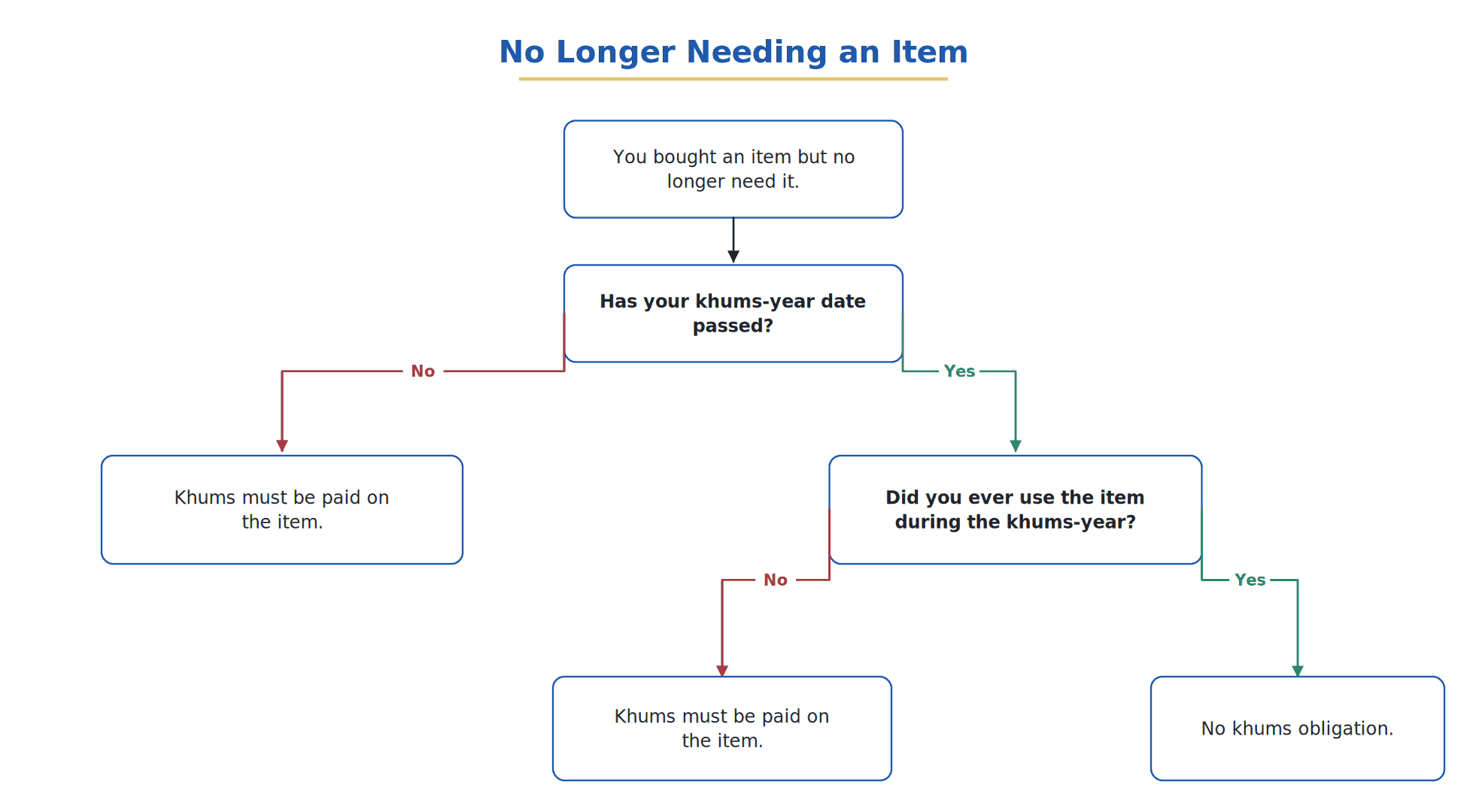
- If one sells the old item and adds its price toward purchasing the new one, and they use it for their annual living expenses appropriate to their status, then there is no khums due on it.
- If one sells the old item and the amount [from its sale] remains with the person until the annual khums due date, then if they have no need for that particular item during that same year, khums must be paid on it based on obligatory precaution.
- If one keeps the old item and leases it out and purchases a new one—such as if the mukallaf moves from their original house to a new, more spacious house purchased from their current year’s profits—then there is no khums due on the rental income if it is spent on their annual living expenses. However, regarding the new residence, there are three scenarios that must be taken into consideration:
- If the original house was sufficient, fulfilled the purpose, and was appropriate for the mukallaf’s status in the view of customary norms (‘urf), while purchasing the second house exceeded their status, then it is obligatory to pay khums on the value of the second house.
- If the original house was cramped, did not fulfill the purpose, or did not match the mukallaf’s status, and they could have purchased a house of lesser value than the one they actually bought—such that if it (i.e., the difference in cost) were added to the first house, it would satisfy their need—then in this scenario, it is obligatory upon them to pay khums on the remaining value of the second house they purchased.
- If moving from the original house was due to other advantages like [better] neighbors, proximity to the workplace, the nature of the neighborhood, or the geographical location, for example, then at that point, the second house is considered part of the annual living expenses, and no khums is due on it, nor on the first house.
Question: If someone purchases a new car and gifts their old car to their child or brother, does khums apply to it?
Answer: If there was a need to purchase the second car because the first one was old or had a defect in it, for example, or something similar, then paying khums is not obligatory on the first nor on the second.
Question: If someone purchases a new smartphone while the old phone still fulfills the purpose, does khums apply to it?
Answer: If purchasing the new phone is considered part of the appropriate annual living expenses and matches one’s status, then there is no khums due on it, nor on the old, used one.
Social Standing/Status (al-Sha’niyyah)
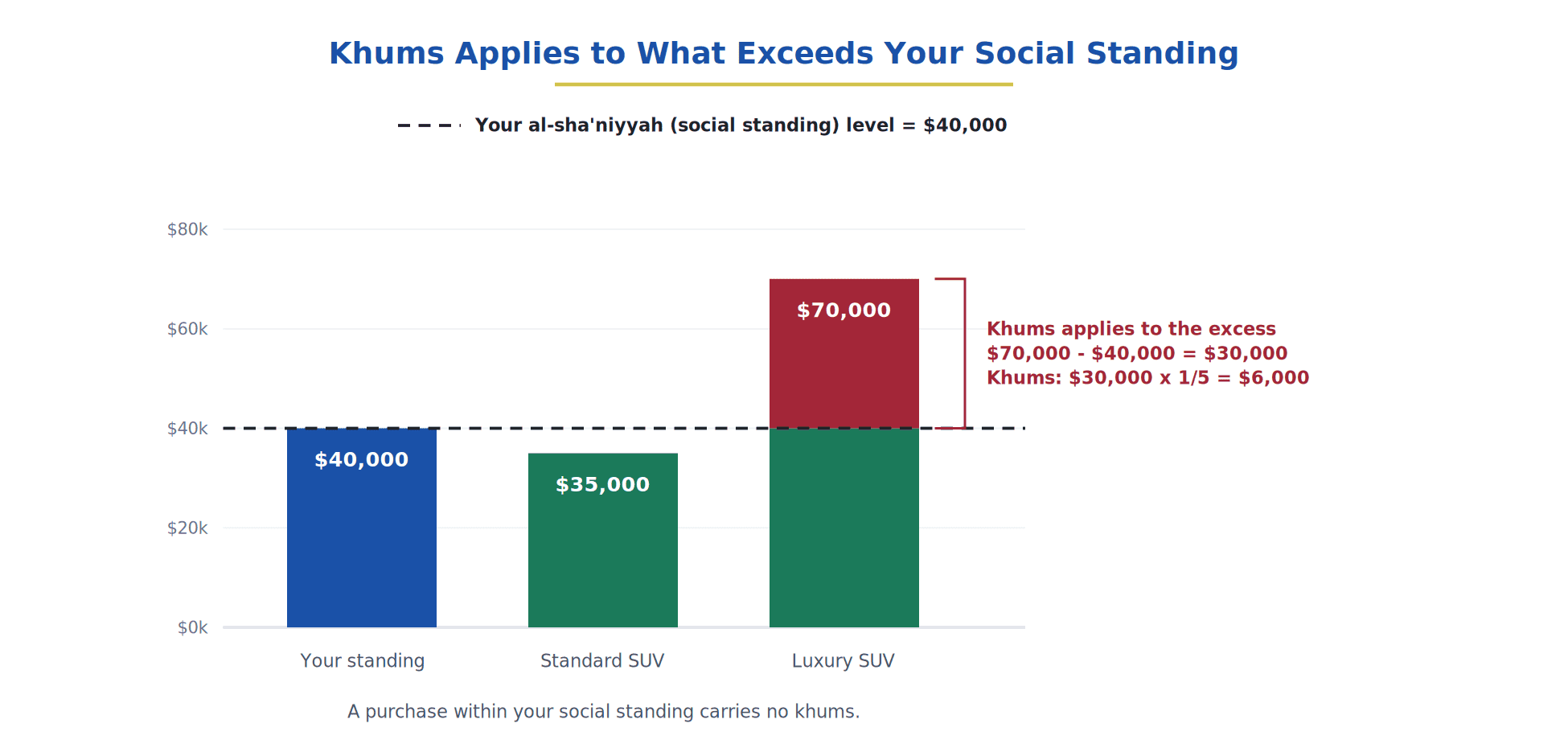
Social standing (al-sha’niyyah) is a subject that branches out from the topic of annual living provisions/expenses. What is meant by it is that the expenditure on annual living provisions must be appropriate to the person’s status in a customary and reasonable manner, such that they would not be blamed for it in the view of reasonable people (al-uqala) and the general customary norms (‘urf). For example, a family consisting of two people might be sufficiently accommodated by a residence comprising two, three, or four rooms at most. If the person chooses a small residence with a single room, thereby cramping themselves and their family, or if they choose a luxurious ten-room residence, for instance, then reasonable people and general customary norms would blame them for either extreme, either stinginess or extravagance. Take someone who works as a lawyer, doctor, or engineer and needs a car; if the customary value [of a car] in the country is $50,000, for example, then custom (‘urf) would view it as a detraction from them if their car were worth $10,000, just as it would view it as extravagance if it cost $200,000, and so on. Therefore, if one is stingy, it is obligatory upon them to pay khums on what they ought to have spent on the annual living expenses appropriate to their status; and if one is extravagant, they must pay khums on whatever exceeds the annual living expenses appropriate to their status.
- If the mukallaf’s social standing changes, the rule changes along with it. For example, if a student of medicine, business, or law purchases a car that is above the level of their status at the beginning of their khums year, and then before the arrival of the annual khums due date, the value of the car drops due to usage or being involved in an accident, or it happens that they graduate from university and acquire a new status as a specialist doctor, a manager of a reputable company, or a lawyer for an esteemed firm—such that custom (‘urf) views that such a car is no longer above their status but rather appropriate to their new status—then no khums is due on it at that point.
- Likewise, if the mukallaf’s social standing changes towards a lesser state, it becomes necessary to pay khums on whatever exceeds their status. An example of this is someone who was supporting themselves, their wife, and five children, and had provided a spacious house that accommodated them all comfortably. Then the children grew up and became independent, leaving the parents, who are content with a house of one or two rooms, for example. In this case, it is necessary to pay khums on whatever exceeds their (i.e., the parents) annual living expenses. Another example is if a person has a high and exceptional job that requires a high-end car, servants, and guards, and then after their retirement and relocation to a retiree housing complex they no longer need all of that. Their social standing has changed, and consequently, their annual living expenses have decreased, so whatever exceeds that (i.e., of items used in their lives) must have khums paid on it.
- Further detail on the difference between common and uncommon inheritance will be explained later. ↩
- A discussion defining it and its conditions will follow later. ↩
- There are certain cases where khums must be paid on an inheritance; these will be discussed in a section dedicated to inheritance. ↩
- A khul‘ divorce (talaq al-khul’) is a type of divorce in Islamic law where the wife, due to aversion to her husband, offers a financial compensation, such as returning her dowry or another payment, in exchange for his agreement to release her from the marriage constitutes. ↩
- Like a government salary—which is of unknown ownership—yet its receipt (possession) is considered valid by the authorization of the hakim al-shar‘i (religious authority). ↩
- On 5 Jumada al-Ula 1422 (corresponding to July 25, 2001), His Eminence Sayyid al-Sistani issued a ruling by virtue of his general religious authority mandating the enactment of state contracts with its employees across its various departments. He decreed that the funds become the property of the recipient immediately upon their deposit into the bank account, without the need for physically taking it in their hand. ↩
- In actuality, khums applies to the profit the moment it is acquired; however, the infallible Imams (pbut)—out of kindness and generosity—have permitted their Shi’a to utilize the profit to cover the living expenses of the mukallaf and their dependents until the end of the year. ↩
- See the list of definitions at the end of the book. The Islamic guardian (al-wali al-shar’i) is exclusively the father and the paternal grandfather, and none other. In their absence, guardianship belongs to the religious authority (al-hakim al-shar’i) and whomever he appoints as a custodian over the affairs of minors. ↩
- Islamic guardianship is established for the fully qualified jurist (al-faqih al-jami’ li-l-shara’it), and whomever he deems appropriate, thereby granting them custodianship and guardianship over the minor or the person afflicted with dementia or insanity. ↩
- Someone who works in a job for a few months, for example, or enters into a profession for a few months is not considered “someone who has work”; rather, they are considered “someone who has no work,” as will be clarified later. ↩
- Discussion of the concession allowing the mukallaf to determine their khums year based on the Hijri calendar, the Gregorian calendar, or others will come later—there is no difference. ↩
- More information to come. ↩